Your Content Isn’t AI-Ready: Here’s How to Fix It

You’ve checked every SEO box: optimized titles, targeted keywords, and published consistently. Yet traffic stays flat, rankings wobble, and your articles never surface in AI answers. The problem isn’t what you’re doing; it’s what modern search systems can’t extract from your content. This gap between optimizing for SEO and being AI-ready is costing you visibility every single day.
Key Takeaways:
- Structure determines AI extractability – well-organized content with clear hierarchy and semantic markup makes it possible for AI systems to parse and reuse your information in answers.
- Traditional SEO creates a readiness ceiling – following keyword checklists and publishing schedules won’t break through if authority signals, freshness indicators, and snippet formats are missing.
- Most content scores in the mid-50s – baseline assessments reveal that pages aren’t broken, they’re stuck with solid structure but weak signals that AI systems need to trust and cite content.
- Four pillars drive AI visibility – freshness, structure, authority, and extractability work together to determine whether search engines and answer systems can understand and surface your content.
Table of Contents:
- The Readiness Ceiling: Why Traditional SEO Feels Stuck
- What Modern Systems Look For: Beyond Classic SEO
- The Four Pillars That Influence AI Readiness
- What Our AI Readiness Assessment Tool Reveals
- How to Create AI-Ready Content
- AEO and SEO Best Practices for Structure-First Content
- Tools and Measurements: How to Verify Progress
- FAQs About AI and Content Structure
- Final Word: Closing the Gap for Real Growth

The Readiness Ceiling: Why Traditional SEO Feels Stuck
You’ve built a content engine. Your team publishes regularly, optimizes metadata, and follows every SEO checklist. On paper, everything looks right. Then reality hits. Organic growth plateaus. Rankings shift between pages with no clear pattern. Months of work produce incremental gains at best.
Common Symptoms
When we analyze sites showing this pattern, the same issues appear:
- Flat or declining organic traffic despite consistent publishing
- Rankings that fluctuate between pages 1-3 with no stability
- Zero appearances in AI-generated answers or featured snippets
- Content that performs well in one search system but disappears in another
The frustration isn’t about effort. Teams work hard, publish quality content, and track metrics religiously. The problem is that traditional SEO addresses only part of what modern systems need. AI search optimization differs from classic approaches so understanding answer extraction is critical.
What Modern Systems Look For: Beyond Classic SEO
Search engines still value keywords, backlinks, and content depth. Those fundamentals haven’t disappeared. But AI systems and answer engines add new requirements that classic SEO never addressed.
Traditional signals tell search engines your page exists and what it covers. Modern systems need structured cues to extract answers, verify trust, and determine if your content deserves citation in AI-generated responses.
The Four Pillars That Influence AI Readiness
Content visibility in 2025 depends on four interconnected factors. Miss any one, and your readiness score drops. At Trustworthy Digital, we built our AI Readiness Assessment Tool to measure exactly these dimensions across your site.
Each pillar affects how search engines and AI systems interpret, trust, and reuse your content. Together, they determine whether your pages can break through the readiness ceiling.
1. Freshness: Signals That Matter in 2026
AI systems prioritize current information when generating answers. Content that looks stale gets deprioritized, even if the information remains accurate. Freshness signals tell systems your page reflects up-to-date thinking and data.
Updating content matters, but timestamps and edit signals matter more. Search engines and AI tools look for clear indicators that you’ve reviewed and refreshed information recently.
AEO Tip: Use schema markup for article publish dates and modification timestamps so AI systems can verify content recency without guessing.
2. Structure: The Heart of AI Comprehension
Humans read context. We infer meaning from surrounding sentences, understand implied connections, and navigate unclear layouts with ease. AI systems can’t do any of that. They rely on formal hierarchy, semantic HTML, and explicit markers to parse content.
Well-structured content increases both readability and extractability. Clear organization signals what matters, how sections relate, and where answers live within your page.
3. Semantic HTML and Hierarchy
Structure determines whether AI can extract useful answers:
- Use H2, H3, and H4 tags with descriptive, intent-focused phrases
- Break long sections into scannable paragraphs under 50 words
- Mark up lists, tables, and key points with proper HTML elements
- Avoid text walls that blur section boundaries
SEO Tip: Internal links with descriptive anchor text reinforce topical relationships and help systems understand how content connects across your site. When building a content SEO strategy, structural hierarchy should drive organization from the start.
4. Authority: Proof Over Claims
AI systems weigh trust signals when deciding whether to cite your content in generated answers. Claims without evidence get ignored. Pages that demonstrate expertise and credibility earn visibility in answer scenarios.
Authority isn’t about domain age or backlink counts alone. It’s about showing, not telling. Evidence, data, case studies, and expert attribution all strengthen how AI systems perceive your trustworthiness.
Signals of Authority
These elements boost credibility in the eyes of both search engines and AI tools:
- Author credentials and demonstrated expertise in the topic area
- Citations of reputable, verifiable sources
- First-party data from case studies or proprietary research
- Quotes or references from recognized authorities in your field

Extractability: Can AI Pull Useful Answers?
Extractability measures how easily AI systems can isolate clear, useful answers from your content. Well-formatted content gets pulled into snippets, answer boxes, and AI-generated responses. Poorly formatted content gets skipped, even when it contains the right information.
Formatting determines whether your content surfaces in answer scenarios. Tables, lists, concise definitions, and FAQ blocks all improve snippet generation.
Best Formats for AI Answering
These formats make content easier to extract and reuse:
- Tables for side-by-side comparisons or data summaries
- Short answer paragraphs that directly address a question
- Bold-highlighted key points that stand out visually
- FAQ subsections formatted with schema markup for questions and answers
What Our AI Readiness Assessment Tool Reveals
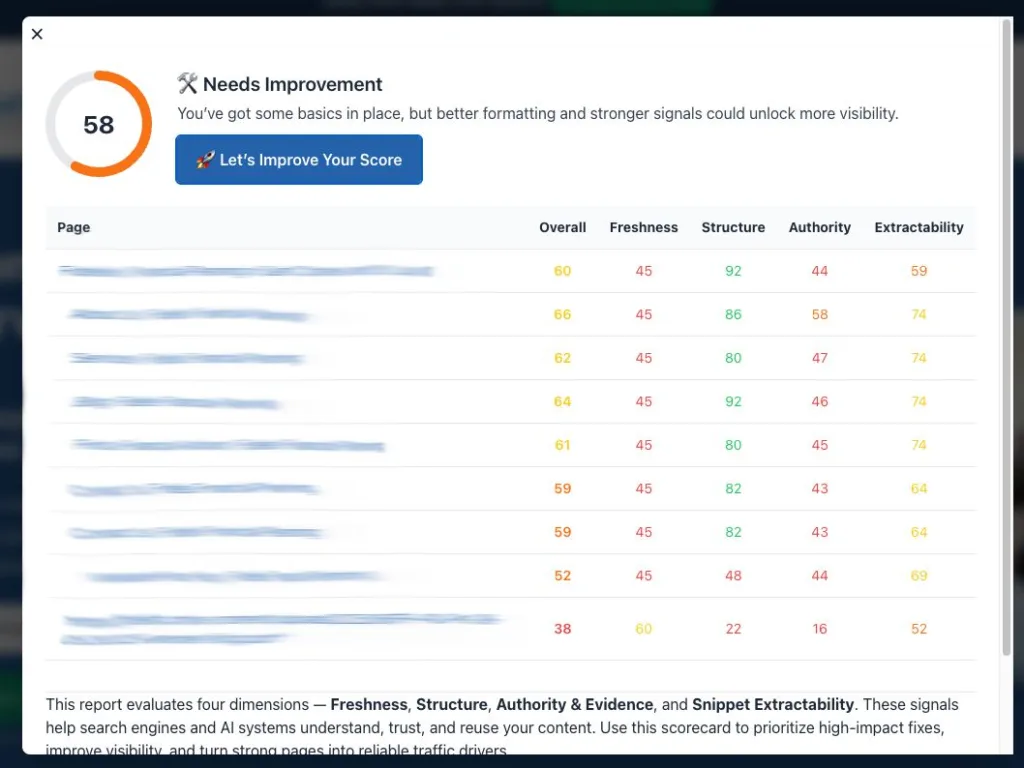
When we launched our AI Readiness Assessment Tool, we expected most sites would show gaps. What surprised us was the consistency of the pattern. Across industries, company sizes, and content types, baseline scores clustered in the same narrow range.
Most pages scored between 52 and 66 overall. Structure often scored high, between 80 and 92. Freshness, authority, and extractability lagged far behind, typically landing in the mid-40s to low-60s range.
What the Scores Mean
These patterns reveal exactly why content feels stuck:
- High structure scores show that content organization makes sense to humans, but weak authority and extractability mean AI systems can’t trust or reuse that content effectively.
- Moderate authority correlates directly with fewer appearances in AI-generated answers and featured snippets.
- Low freshness signals reduce perceived relevance, even when information remains accurate and useful.
SEO Tip: Baseline scores provide a starting point for prioritizing fixes. Focus first on the pillars with the lowest scores for the fastest visibility gains.
How to Create AI-Ready Content
Becoming AI-ready doesn’t require rebuilding your entire content library. Small, targeted changes compound into stronger signals that modern systems can interpret and act on. The key is addressing gaps systematically. Start with the pillars where your scores lag most, then apply fixes across high-priority pages before scaling to the rest of your site.
Step 1: Reframe Your Headings
Headings guide both human readers and AI systems through your content. Intent-focused headings improve extractability:
- Use natural language that matches how people ask questions
- Place primary and secondary keywords near structural markers like H2 and H3 tags
- Avoid generic phrases like “Overview” or “Introduction” that provide no context
Step 2: Add Semantic Markup
Schema markup translates your content into structured data that AI systems can parse reliably:
- Use FAQ schema for question-and-answer sections
- Apply HowTo schema for step-by-step instructions
- Add Article schema with publish and modification dates
- Implement Breadcrumb schema to clarify site navigation
Step 3: Build Trust Signals
Authority comes from evidence, not assertions. Strengthen trust by:
- Citing credible, verifiable sources for claims and statistics
- Including detailed author bios that demonstrate expertise
- Referencing recognized authorities or industry leaders
- Publishing case studies or first-party research that shows real results
For a comprehensive breakdown of tactics that drive measurable improvements, our guide on the most effective strategies for AI visibility covers advanced implementation approaches.
AEO and SEO Best Practices for Structure-First Content
Modern content strategies must balance traditional SEO fundamentals with the structural and signal requirements that AI systems need. A unified readiness-first approach drives greater discoverability across search engines, answer engines, and AI-powered tools.
Structural elements help both human readers and automated systems interpret your content accurately. When you optimize for answer engine optimization, you’re building content that works across every discovery channel.
Checklist for AI-Ready Content
Use this checklist to verify that pages meet modern readiness standards:
- Clear hierarchy with descriptive H2, H3, and H4 headings
- Concise paragraphs under 50 words for scannability
- Frequent internal links with 2-4 word anchor text that describes the destination
- FAQ blocks formatted with schema markup
- Tables or lists for comparisons and data summaries
- Schema markup for articles, FAQs, HowTos, and other structured content types
Common Pitfalls to Avoid
These mistakes limit extractability and signal strength:
- Long, unbroken text blocks that make answers hard to isolate
- Generic titles and headings that lack intent or context
- Missing schema markup for structured content
- Vague claims without citations or evidence
If you’re managing content strategy internally but feel stuck, it might be time to consider hiring a marketing agency that’s already winning in the new AI-driven landscape.
Tools and Measurements: How to Verify Progress
Tracking improvements requires measuring the same dimensions that affect readiness. At Trustworthy Digital, our AI Readiness Assessment Tool provides baseline scores across freshness, structure, authority, and extractability. Use this data to prioritize fixes and track how changes improve visibility over time.
Measurement ties directly to outcomes. Better readiness scores correlate with stronger rankings, more featured snippet appearances, and higher click-through rates from search results.
Suggested KPIs
Monitor these metrics to verify that readiness improvements translate to visibility gains:
- Appearances in AI-generated answers and featured snippets
- Click-through rates from organic search results
- Rankings for high-intent keywords in your target market
- Traffic from answer engines and AI-powered search tools
FAQs About AI and Content Structure
Why doesn't AI use my page even though it ranks?
Can structure influence snippet selection?
Is schema markup necessary for AI readiness?
How often should I update content for freshness?
Final Word: Closing the Gap for Real Growth
Traditional SEO fundamentals still matter. Keywords, backlinks, and content depth remain essential. But modern visibility requires evolving beyond checklists into readiness thinking that accounts for how AI systems extract, trust, and reuse information.
The gap between content that ranks and content that surfaces in AI answers isn’t about effort. It’s about structure, signals, and extractability. Close that gap, and your visibility compounds across every discovery channel.
Ready to Measure Your AI Readiness?
Most content isn’t broken. It’s stuck. Our AI Readiness Assessment Tool shows exactly where your pages stand across freshness, structure, authority, and extractability.
Run your site through the assessment to get baseline scores, identify priority fixes, and build a roadmap to get your site AI-ready for 2026 and beyond. It’s free, unbiased, and designed to give you actionable insights in minutes.
Get Your AI Readiness Score Now
About the Author: Lary H. Stucker
Lary brings more than 20 years of leadership experience guiding enterprise organizations and nonprofits through marketing transformation and growth. As Chief Operating Officer of Trustworthy Digital, he oversees digital strategy, automation, web and software development, and the deployment of AI agents that enhance efficiency, decision-making, and client impact.
View all posts →