Mid-Market Organic Traffic Dropped 35%. Here’s Why Our Clients Grew Instead

Mid-Market Organic Traffic Dropped 35%. Here’s Why Our Clients Grew Instead
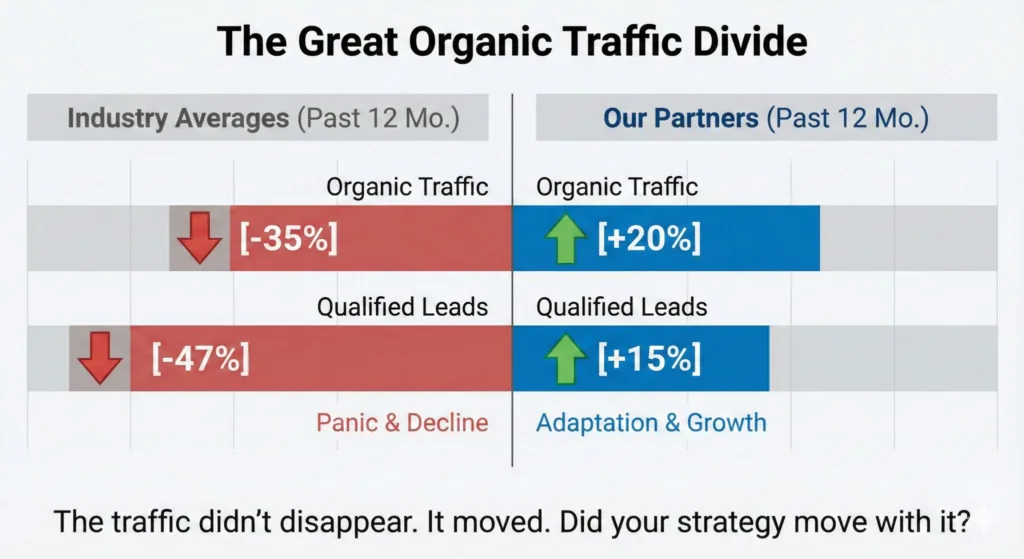
Over the past 12 months, organic traffic across most industries fell by roughly 35%. Qualified leads dropped even harder, nearing 50% in many sectors. Yet some brands grew during this exact period, capturing market share while competitors blamed external forces.
The difference wasn’t luck or budget. It was strategy. At Trustworthy Digital, we watched traffic shift into new discovery environments rather than disappear entirely. AI readiness determines whether your content can be extracted and reused by modern search and AI systems, which directly affects where and how your brand shows up. The brands that adapted early are now pulling ahead, and the gap keeps widening.
Key Takeaways
- Traffic shifted, not vanished – Organic demand moved into new surfaces like AI answers, off-site citations, and zero-click environments.
- Average strategies failed – Legacy SEO tactics couldn’t adapt to AI-driven discovery patterns.
- Adaptation drove growth – Clients aligned to AEO and GEO captured market share competitors lost.
- Measurement evolved – Success required tracking readiness, extractability, and off-site influence.
The Great Organic Traffic Divide
The past year created a sharp divide between brands losing visibility and brands gaining it. This wasn’t a temporary dip or seasonal trend. The gap between winners and losers widens every month, and it’s still growing.
What split these two groups wasn’t market conditions or ad spend. It was how quickly teams recognized that search behavior had fundamentally changed, and whether they adjusted their approach to match.
What the Industry Data Actually Shows
Industry benchmarks reveal organic traffic declined by approximately 35% across most verticals. That number alone signals a major shift, but the lead quality numbers tell an even sharper story.
Qualified lead volume fell closer to 50% in many cases. Traffic dropped, but conversion rates dropped harder, meaning fewer visitors and fewer of them took action. The combination hit revenue pipelines fast.
Why “Market Conditions” Is the Wrong Explanation
- Demand didn’t collapse.
- Search behavior changed faster than strategies.
- AI systems altered how visibility is earned and distributed.
Two Reactions to the Shift in Search
Most marketing teams reacted to traffic declines by increasing content output and refreshing keyword targeting. They assumed volume and optimization would reverse the trend. It didn’t work.
A smaller group took a different approach. They restructured how content was built, measured what mattered beyond clicks, and optimized for how AI systems extract and surface information. That group grew.
Reaction One: Panic and Decline
When traffic dropped, most teams defaulted to what worked in 2019, doubling down on content volume and chasing keyword rankings harder. The approach failed because it ignored how discovery had fundamentally changed.
What Panic Looks Like in Practice
- Chasing rankings without understanding extraction.
- Publishing volume without structural readiness.
- Measuring traffic while ignoring off-site visibility.
Reaction Two: Adaptation and Growth
A smaller group recognized the shift and adjusted accordingly, optimizing for how AI systems extract and surface content across multiple environments. These teams restructured content, refined authority signals, and built measurement frameworks tracking visibility beyond pageviews.
What Adaptation Looks Like in Practice
- Optimizing for AI reuse, not pageviews alone.
- Structuring content for answers, not articles.
- Tracking readiness and off-site signals alongside rankings.

Why Our Clients Grew While the Industry Shrunk
Trustworthy Digital clients didn’t rely on legacy SEO playbooks that prioritized keyword density and backlink counts. Instead, we shifted toward Answer Engine Optimization and Generative Engine Optimization, optimizing for how content gets discovered and used today.
That shift required rethinking structure, authority signals, and measurement frameworks. It also required accepting that traditional traffic metrics don’t capture the full picture anymore. Brands that made these adjustments captured the market share competitors lost.
The Results That Matter
Our clients saw measurable growth while competitors declined. The numbers reflect strategic shifts toward AI readiness, not incremental improvements from legacy tactics.
- 20% increase in overall organic traffic
- 15% increase in organic lead volume
- 20x growth in AI-driven traffic sources
AEO and GEO: The Strategic Shift Most Brands Missed
AEO focuses on how answers are extracted and cited by AI systems. It’s about making content easy to pull, reuse, and attribute. If your content can’t be cleanly extracted, it won’t appear in AI-generated responses.
GEO ensures content performs inside generative systems, not just traditional search results. These systems prioritize clarity, authority, and structure over keyword match. Optimizing content for generative search requires different formatting, different signals, and different measurement. Learn more about Answer Engine Optimization.
Why Traditional SEO Plateaued
Traditional SEO metrics don’t capture how AI systems decide what to extract and cite. Rankings alone no longer guarantee visibility or discovery.
- Rankings don’t guarantee visibility in AI answers.
- Keywords don’t explain trust or authority.
- Click-based metrics miss off-site discovery.
With AI search optimization, brands stay visible as discovery patterns evolve.
The Role of Off-Site Signals in Modern Search
AI systems surface content beyond direct website visits. They pull information from your site and display it elsewhere, sometimes without sending a click. That creates visibility you can’t measure with traditional analytics.
Off-site mentions, citations, and references influence how often your brand appears in AI-generated answers. These signals act like “dark social” for search, driving awareness and trust without showing up in session counts. At Trustworthy Digital, we track these indicators through our proprietary Trustworthy Signals® framework, measuring the digital footprint your brand creates across the web. The impact is real, even when the data isn’t immediately visible.
Why Analytics Underreport Real Impact
Traditional analytics can’t track when AI systems surface your content without sending clicks. Visibility often happens where you can’t measure it directly.
- Zero-click answers don’t show as traffic.
- AI citations drive delayed brand searches.
- Visibility often precedes measurable sessions.
Tracking Google Analytics KPIs helps, but only if you’re measuring the right signals for today’s discovery environment.
Mid-Market Brands Don’t Need More Content
Publishing more doesn’t solve structural gaps. If your existing content isn’t optimized for extraction, authority, and readiness, adding volume just creates more content that won’t perform. Strategy has to come first.
Most teams assume declining traffic means they need to produce more. The reality is different. Brands need better structure, clearer signals, and content designed for how AI systems decide what to show and cite.
What They Actually Need
Brands need content structured for AI extraction, clear authority signals, and measurement systems that track visibility beyond traditional sessions and pageviews.
- AI-ready structure
- Clear authority signals
- Extractable answer formats
- Measurement beyond clicks
The intersection of AI and content marketing requires rethinking production workflows and quality benchmarks, not just output volume.

How We Built a Strategy That Moves With Search
Trustworthy Digital refined its approach through testing and iteration over the past year. We tracked what worked, what didn’t, and what signals mattered most as AI systems became more prominent in discovery.
The focus stayed on readiness, extraction, and long-term visibility. We didn’t chase short-term ranking bumps or traffic spikes. We built for sustainable growth in an environment where visibility happens off-site as often as it happens on-site.
What We Measure Instead of Guessing
We track signals that predict long-term visibility across traditional search and AI systems. These metrics reveal performance before it shows in standard analytics.
- Readiness across structure, authority, and freshness
- AI answer appearances
- Off-site citation patterns
- Conversion quality, not just volume
The most effective strategies for AI visibility combine multiple signals into a cohesive framework that tracks both traditional and emerging metrics.
What This Means for Your Team
Blaming market conditions delays real fixes. Traffic didn’t disappear because the economy slowed down or because Google changed an algorithm. It shifted because discovery patterns changed, and the brands that adapted early are now capturing share from the ones still waiting.
The gap between winners and losers continues to widen. Brands that adjust now gain compounding advantages. Those that wait fall further behind every quarter.
Traffic Didn’t Disappear, It Shifted
Search evolution created winners and losers. Traffic moved, discovery patterns changed, and the brands that recognized the shift early are now gaining the market share competitors lost.
Adaptation is the differentiator. The teams that adjusted their strategy, measurement, and structure are growing. The ones still relying on 2019 playbooks are declining.
Ready to See Where You Stand?
If your traffic dropped over the past year, it might not be market conditions. It might be that your strategy hasn’t caught up to how search works now. Getting a second opinion can reveal what’s missing.
Trustworthy Digital helps mid-market brands navigate AI-driven search with strategies built for today’s discovery environment, not yesterday’s ranking algorithms. We measure what matters, optimize for extraction, and track the signals that actually drive growth.
About the Author: Lary H. Stucker
Lary brings more than 20 years of leadership experience guiding enterprise organizations and nonprofits through marketing transformation and growth. As Chief Operating Officer of Trustworthy Digital, he oversees digital strategy, automation, web and software development, and the deployment of AI agents that enhance efficiency, decision-making, and client impact.
View all posts →