

Generative AI is changing how RIAs and wealth management firms operate, communicate, and compete for qualified clients. Firms are using AI to improve efficiency across marketing, client communication, reporting, and operational workflows. However, in a highly regulated industry, AI works best when supported by strong governance, human oversight, and a clear growth strategy.
In this guide, we’ll explain what generative AI means for RIAs, walk through 10 practical examples of how firms are applying it across operations and marketing, cover what to consider before adopting new AI tools, and show how Trustworthy Digital helps firms apply AI strategically through AI visibility, workflow automation, and the Revenue Performance System.
Key takeaways
- AI supports communication, not fiduciary judgment – Generative AI helps advisor teams draft market updates, meeting summaries, and marketing content, but human review and compliance oversight remain essential at every step.
- Disconnected tools produce disconnected results – The most effective AI strategies solve specific operational or marketing challenges rather than introducing standalone tools without clear business impact.
- AI visibility is now a competitive factor – RIAs that optimize for AI Overviews, Answer Engine Optimization, and generative search are more likely to be cited when prospects search for financial guidance.
- Local discoverability drives RIA growth – Generative AI supports location page content, GBP updates, and localized FAQs, helping multi-location firms compete at the advisor office level.
- Governance is not optional – Firms should establish internal AI policies covering approved tools, recordkeeping requirements, PII protection, and human approval workflows before scaling AI adoption.
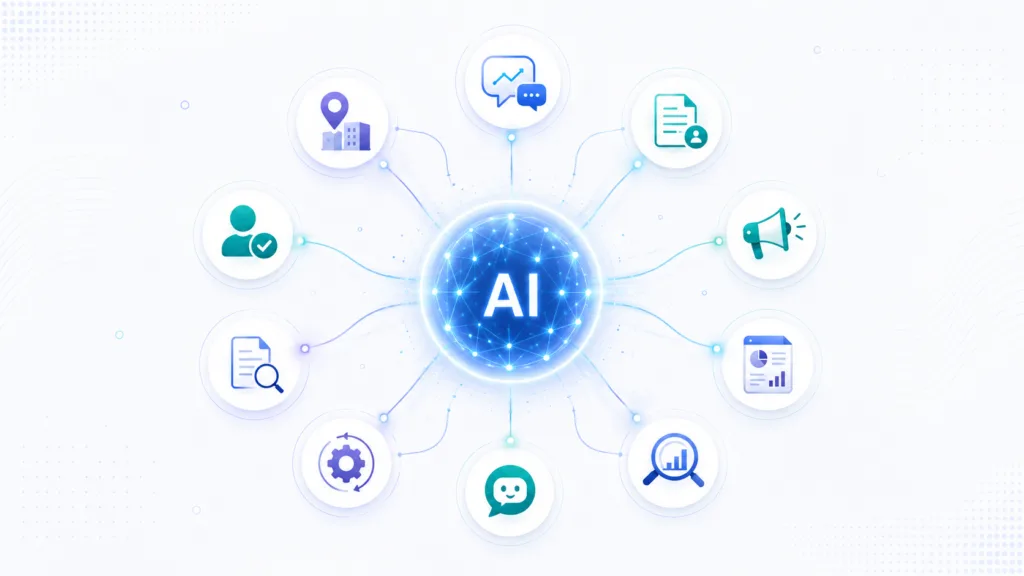
What is generative AI for financial services?
Generative AI refers to AI systems that produce new content, summaries, recommendations, workflows, and conversational responses rather than simply retrieving or sorting existing information. In financial services, that includes tools that draft client communications, analyze research, automate internal workflows, and support content and marketing processes.
For RIAs, the most practical applications go beyond general automation. Firms use AI to reduce administrative burden, improve communication consistency, accelerate operational workflows, and support visibility in competitive markets.
The strongest results come when AI operates within clear governance frameworks that keep human review, compliance oversight, and fiduciary judgment at the center of client-facing decisions.
10 practical examples of generative AI in financial services
The most effective generative AI strategies solve specific operational, marketing, and client experience challenges instead of introducing disconnected tools without clear business impact. The examples below reflect how RIAs are applying AI to real problems across their firms.
1. AI-generated market commentary and client updates
Advisor teams use generative AI to help draft market updates, portfolio commentary, newsletters, and economic summaries. Rather than building these from scratch each communication cycle, teams work from AI-generated drafts that human reviewers and compliance staff refine and approve before distribution.
Human and compliance review remain essential. AI supports communication efficiency and consistency, not fiduciary judgment. Firms treat AI as a starting point rather than a finished product, which helps maintain client touchpoint volume without sacrificing accuracy or regulatory responsibility. The communication strategy, review process, and performance measurement still determine whether that volume produces results.
2. AI-powered meeting summaries and CRM workflows
RIAs deal with significant administrative overhead following advisor-client meetings. Generative AI reduces that burden by automating several steps in the post-meeting workflow.
- AI transcribes the advisor meeting
- Key topics and action items are summarized
- Follow-up emails are drafted for advisor review
- CRM notes are organized automatically
- Internal tasks are assigned based on action items
Firms should maintain proper recordkeeping and retention policies for AI-generated summaries, consistent with SEC and FINRA expectations. Faster follow-up is only an advantage when the workflow is built around quality oversight, not just speed.
3. Personalized marketing content at scale
RIAs use generative AI to produce segmented email campaigns, local office content, nurture workflows, landing page messaging, and advisor-specific personalization at a pace manual production cannot match. The best results come when AI operates within a strong editorial framework that applies subject matter expertise and audience segmentation before anything is published.
AI can accelerate content production, but firms still need a clear content strategy, editorial oversight, and performance measurement to improve lead quality and visibility. Higher content volume produces more activity, not better pipeline, without segmentation and conversion tracking behind it.
4. AI agents for internal reporting and executive summaries
Many RIAs operate with disconnected reporting systems and fragmented visibility data spread across CRM platforms, GA4, SEO tools, pipeline systems, and advisor location reporting. AI agents pull from these sources and consolidate outputs into structured, decision-ready summaries for marketing leaders and firm executives. AI agents built for SEO and reporting workflows show how this plays out in practice.
Common outputs include:
- Weekly marketing summaries
- Lead quality reporting
- Executive performance updates
- Advisor office visibility reporting
- Pipeline attribution summaries
Consolidated reporting creates an advantage only when leadership uses those summaries to adjust strategy, not simply to review activity.
5. AI-assisted SEO, AEO, and AI visibility optimization
Prospects are increasingly finding answers through AI Overviews, conversational search, and generative engines rather than traditional results pages. RIAs that optimize for Answer Engine Optimization (AEO) and generative engine optimization (GEO) are better positioned to be cited when prospects search for financial guidance.
AI search optimization has become a core component of an effective RIA marketing strategy. Generative AI supports this work across several areas:
- Metadata recommendations
- FAQ generation for conversational search
- Schema markup suggestions
- Topical coverage analysis
- AI visibility monitoring and reporting
AI can help identify opportunities, but improving AI visibility still requires a structured SEO, AEO, and content strategy. Firms that gain citation share in AI search have a clear topical authority strategy behind them, not just optimized metadata.
6. AI chatbots and client support assistants
AI-powered client support tools fall into three distinct categories: basic chatbots that handle simple routing, conversational AI assistants that manage more nuanced interactions, and internal advisor copilots that support team workflows rather than client-facing functions.
Practical applications for RIAs include:
- Onboarding question handling
- Appointment scheduling support
- Educational content delivery
- FAQ handling for common investor questions
- Support request routing to the right team member
Firms should avoid exposing sensitive client financial information to unsecured public AI tools. Escalation paths to human advisors remain essential, and AI should not independently provide personalized investment advice without human oversight. A well-defined scope and escalation path determine whether client support AI improves the experience or creates compliance risk.
7. AI agents for workflow automation
AI agents handle repeatable internal tasks, reducing manual work across marketing and operations teams. Common workflow applications include:
- Lead routing based on qualification criteria
- Nurture email triggers based on engagement signals
- Form submission monitoring and response
- Internal notifications for prospect activity
- Reporting workflow automation
- Client onboarding support sequences
- Advisor recruiting workflow support
Firms should establish clear internal AI governance policies that define approved tools, workflow usage, and review requirements before deploying agents across operational systems. The qualification criteria, trigger logic, and review checkpoints still require human judgment to produce outcomes worth measuring.
8. Faster research and due diligence workflows
Generative AI helps advisor teams synthesize large volumes of research more efficiently. SEC filings, market research, investment commentary, competitor analysis, and industry reports can be summarized and organized faster, allowing teams to focus on decision-making rather than document processing.
Human validation remains critical. AI-generated insights can contain inaccuracies or reflect incomplete source material, which makes advisor review essential at every step. Speed to synthesis only helps when the review process is structured well enough to catch gaps before they influence decisions.
9. Enhanced lead qualification and conversion support
Generative AI helps RIA marketing teams identify high-intent prospects, surface engagement patterns, and reduce conversion friction before opportunities fall out of the funnel. AI tools that surface the right prospects at the right time contribute directly to shorter sales cycles and less wasted outreach.
Practical applications include:
- Lead scoring based on behavioral signals
- Follow-up timing recommendations
- Nurture sequence optimization
- Behavioral segmentation by engagement type
- Conversion analysis by channel and content
Lead scoring and behavioral signals produce qualified pipeline only when the ICP definition, segmentation strategy, and conversion measurement are calibrated to actual growth goals.
10. Local visibility and multi-location marketing support
RIAs with multiple locations compete aggressively through local visibility and advisor office discoverability. Generative AI supports this through location page content, Google Business Profile updates, localized FAQ development, office-specific content, local review response support, and multi-location consistency management.
Local SEO is built around making sure each advisor office is visible and credible in its local market. Firms building RIA marketing strategies at the multi-location level are increasingly using AI to close the content gap that manual production alone cannot fill.
AI can speed up content creation and local marketing workflows, but firms still need a strategy for local visibility, reputation management, and office-level performance measurement. Tracking which offices improve in local rankings and which generate qualified inquiries is what turns content production into a growth strategy.

What RIAs should consider before adopting generative AI
Successful AI adoption requires governance, oversight, and operational discipline alongside efficiency improvements. Efficiency alone is not sufficient reason to deploy new AI tools without a clear framework for how they will be used, reviewed, and managed.
Key considerations include:
- SEC recordkeeping expectations for AI-generated communications and summaries
- Data privacy and PII protection across all AI tools and platforms
- Human review and approval workflows for client-facing outputs
- Internal AI governance policies covering approved tools and usage
- Hallucination and accuracy risks in AI-generated research and content
- Vendor security standards and data handling practices
- Archiving and retention requirements for AI-generated outputs
- Approved tool usage policies communicated across the advisory team
How Trustworthy Digital helps RIAs apply AI strategically
Trustworthy Digital works with RIAs to apply AI in ways that improve qualified pipeline, strengthen advisor discoverability, and build a measurable path from marketing activity to revenue. The 2026 Search Visibility Playbook reflects how that strategy is evolving for RIAs competing in AI-influenced search environments.
Our work in this area spans:
- AI visibility optimization through AEO and GEO strategy
- AI agent development for reporting and workflow automation
- Pipeline-focused performance reporting
- Trustworthy Signals for AI citation monitoring
- AI Readiness Assessments to identify where AI can improve marketing and operational efficiency
- The Revenue Performance System as the connected framework that ties it all together
AI works best as part of a connected performance system, one that links visibility, conversion, reporting, and workflow execution to qualified pipeline and long-term growth.
Run your free AI readiness assessment
See where AI can improve visibility, operational efficiency, and qualified pipeline generation across your marketing and growth systems.
Frequently asked questions
What are the most common generative AI use cases for financial services?
How are RIAs using generative AI?
How are AI agents used in financial services?
Is generative AI safe for RIAs?
How can RIAs use generative AI?
Are there compliance risks of generative AI in wealth management?
Can generative AI improve lead generation?
Build a smarter AI strategy for financial services growth
Generative AI creates real operational and marketing advantages for RIAs, but only when connected to clear business outcomes. Efficiency gains that don’t translate to qualified pipeline, stronger visibility, or better conversion are improvements in the wrong direction. Firms that see consistent results apply AI within a structured performance system, not as a collection of standalone tools.
The Revenue Performance System connects visibility, conversion, reporting, and workflow execution so every part of your marketing operation contributes to firm growth. If you’re ready to see where AI fits into that picture, a Performance Diagnostic is the right place to start.