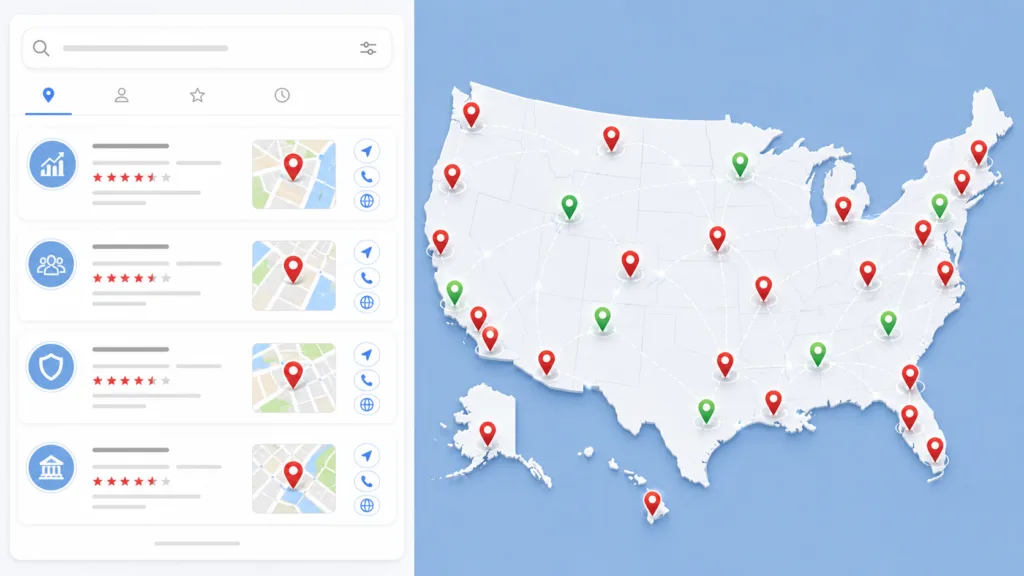
Local visibility directly affects whether a multi-location RIA appears when a prospect searches for a financial advisor in a specific city or market. Prospects evaluate advisory firms through Google Business Profiles, local search results, reviews, and location pages before ever scheduling a consultation. For growing firms, inconsistent local presence means uneven lead flow, weaker rankings, and missed pipeline.
As AI-driven discovery continues to shape how prospects find and evaluate firms, the gap between well-optimized and under-optimized offices will only widen. In this guide, we’ll explain why local visibility matters for multi-location RIAs, what weak local presence looks like, which elements have the biggest impact on qualified pipeline, and how to build a scalable system across every market.
Key takeaways
- Local visibility drives qualified pipeline: Strong local search presence helps RIAs attract more qualified opportunities in each market they serve, not just more traffic.
- Inconsistency across offices costs pipeline: When profiles, reviews, and location pages are managed unevenly, some offices generate leads while others stall.
- GBP is often the first touchpoint: Many advisor searches begin and end inside Google’s local results before a prospect ever visits a firm’s website.
- Location pages support market expansion: Well-structured local pages help firms compete in more geographic markets and rank beyond branded searches.
- Reviews influence rankings and conversion: Review volume, response quality, and consistency shape both how firms rank and how prospects evaluate them.
- Scalability requires a system: Local visibility built on one-time setup tasks does not compound. Firms that treat it as an ongoing growth asset outperform those that don’t.

Why local visibility matters for multi-location RIAs
Wealth management searches are inherently geographic. When a prospect searches for “financial advisor in [city]” or “wealth management firm near me,” they are actively looking for a financial advisor in their area. For multi-location RIAs, appearing consistently in those results across every market is a direct driver of qualified pipeline.
Local visibility extends beyond rankings alone. Prospects evaluate firms through Google Maps results, reviews, office location pages, business directories, and increasingly, AI-generated recommendations. Firms building stronger RIA marketing strategies treat each of these touchpoints as an opportunity to improve discoverability, reinforce credibility, and generate qualified opportunities across every market they serve.
| Where prospects discover firms | Why it matters |
| Google Maps and local results | Often the first touchpoint during advisor research |
| Firm location pages | Provide local credibility and service information |
| Reviews | Help prospects evaluate trust and reputation |
| Local business directories | Reinforce consistency across the web |
| AI-generated answers | Surface firms during research without a traditional search click |
Multi-location RIAs face a compounding challenge. An established office may rank well and generate consistent consultations while newer offices sit invisible in their local markets. That imbalance is usually caused by differences in how well each office is represented online.
What weak local visibility looks like for RIAs
Weak local visibility often appears as uneven performance across offices. Some locations generate a steady flow of consultations while others struggle to attract qualified opportunities. In many cases, the difference is not market demand. It’s how effectively each office is represented across local search, reviews, and digital touchpoints.
Some offices generate leads while others struggle
Inconsistent local visibility creates uneven pipeline contribution across a firm’s office footprint. An office in a competitive market may struggle to attract opportunities because its local presence is weaker than nearby competitors. Newer offices are especially vulnerable when there is no structured process for building visibility and credibility in the market.
Over time, these gaps create a situation where a handful of locations drive most consultations while other offices contribute little despite serving similar audiences.
Prospects can’t easily evaluate the office online
For many prospects, Google is the first place they evaluate an advisory firm. Incomplete map pack business profiles (Google Maps, Bing Maps, Apple Maps), outdated office information, limited photos, and inconsistent service details make it harder for prospects to trust what they find.
Small gaps may seem insignificant, but collectively they can reduce visibility and discourage prospective clients from taking the next step.
Common issues include:
- Inaccurate office information
- Generic firm descriptions
- Limited photos and updates
- Missing service information
- Inconsistent profile management across locations
Location pages provide little local relevance
Location pages help prospective clients understand who the firm serves, what services are offered, and why the office is relevant to their market. When those pages contain generic or duplicated content, they often fail to build trust or support visibility in local search.
As a result, offices miss opportunities to appear during advisor research, particularly in competitive markets where prospects are comparing multiple firms.
Competitors become easier to discover
Strong local visibility is relative. Prospects typically compare several firms before scheduling a consultation. Firms with stronger reviews, more complete local profiles, and better market visibility are often easier to discover and evaluate during that process.
Over time, those advantages compound. Offices that consistently appear in local searches, earn reviews, and maintain a strong digital presence often capture a larger share of local demand.

The local visibility elements that have the biggest impact
Strong local visibility is rarely the result of a single tactic. The firms that consistently appear in local searches and generate qualified opportunities typically invest in several visibility assets working together.
Optimized Google Business Profiles improve discovery
Google Business Profiles (GBPs) are often the first thing a prospective client sees when evaluating an advisory firm. Complete profiles, accurate office information, professional imagery, and active review management make it easier for prospects to trust what they find and take the next step.
Firms that actively manage their profiles tend to be more visible in local searches and better positioned to convert that visibility into consultations.
Strong profiles typically include:
- Accurate office information
- Relevant service descriptions
- Professional office photos
- Consistent review activity
- Regular profile maintenance
Firms that treat GBP as a one-time setup task leave meaningful visibility and conversion opportunities behind.
Strong location pages improve local search rankings
Location pages help RIAs rank for geographic searches beyond branded terms. To perform, each page needs the following.
| Page element | Why it matters |
| Market-specific copy | Demonstrates relevance to local prospects |
| Localized FAQs | Answers questions prospects commonly ask before reaching out |
| Advisor credibility signals | Builds trust before a consultation is scheduled |
| Service information | Clarifies how the office helps clients |
| Internal connections to related content | Helps prospects continue researching the firm |
Well-built location pages give prospects a reason to trust the firm before making contact, not just a reason to click.
Reviews influence both rankings and conversions
Prospects often evaluate reviews before visiting a website or scheduling a consultation. A strong review profile can improve local visibility while also reinforcing credibility during the decision-making process.
Firms with consistent review generation and response workflows are often better positioned to scale reputation management across multiple offices.
Consistent local authority strengthens market presence
Local authority is built through consistent references to the firm across trusted websites, business directories, local organizations, and industry resources. These signals help reinforce credibility and strengthen visibility within a market.
Local authority also influences how firms appear in emerging AI-driven discovery experiences. Firms with stronger visibility and trust signals are more likely to be surfaced when prospects research advisors through AI-powered tools.
Tools like Trustworthy Signals™ help firms understand when they are being surfaced in AI-driven discovery experiences and where visibility opportunities exist across markets.

Why multi-location RIAs struggle to scale local visibility
Most multi-location RIAs struggle with local visibility because of operational complexity, not market conditions. Without a centralized approach, local visibility efforts often vary from office to office, making it difficult to maintain consistency, measure performance, and identify growth opportunities.
Common failure points include:
- Inconsistent execution across offices: Some locations receive ongoing attention while others operate with outdated profiles, limited reviews, or underdeveloped location pages.
- Fragmented digital presence: Acquisitions, mergers, and advisor transitions often leave behind duplicate listings, inconsistent information, and competing local profiles.
- National focus, local neglect: Marketing investments often focus on brand awareness while individual offices struggle to compete in their local markets.
- One-time setup mentality: Location pages and GBPs are treated as tasks to complete, not assets to grow.
- Limited office-level visibility: Leadership can see overall marketing performance but lacks insight into which offices are generating opportunities and which need additional support.
The result is a firm with strong brand recognition but uneven market-level performance. While the organization may appear highly visible nationally, individual offices often struggle to attract the qualified opportunities that drive local growth.
What scalable local visibility looks like for RIAs
Scalable local visibility means consistently appearing where prospective clients research financial advisors across every market you serve. The most effective omnichannel marketing for RIAs aligns local search, reputation management, website experience, and reporting into a system that supports growth across the entire office footprint.
| What it looks like | Why it matters |
| Standardized local visibility processes | Creates consistency across every office and market |
| Structured review generation | Builds trust and credibility at scale |
| Market-specific location pages | Helps offices attract qualified local opportunities |
| Connected website experience | Makes it easier for prospects to research and engage with the firm |
| Office-level performance reporting | Shows which markets are contributing to pipeline growth |
| Faster market launches | Supports expansion into new geographic areas |
| Recruiting and acquisition support | Strengthens visibility for incoming advisors and acquired offices |
Firms that build this structure create a more predictable growth engine across their office footprint. Instead of relying on a handful of high-performing locations, they can improve visibility, generate qualified opportunities, and measure contribution market by market.
Our Revenue Performance System connects local visibility efforts to qualified pipeline reporting, giving leadership a clearer view of which markets are driving growth and where additional investment is needed.
How Trustworthy Digital helps RIAs strengthen local visibility
Trustworthy Digital helps multi-location RIAs strengthen local visibility across every market while connecting those efforts to qualified pipeline growth.
Our work includes:
- GBP optimization and management: Across all office locations, not just flagships
- Scalable location page strategy: Market-specific pages that help each office attract and convert local opportunities
- Review generation workflows: Designed for consistent execution across teams and offices
- Office-level pipeline reporting: Tied to qualified opportunities, not vanity metrics
- AI visibility monitoring via Trustworthy Signals: Helps firms understand how content is being discovered, shared, and referenced across AI, social, and messaging platforms.
All of this connects to the Revenue Performance System, which gives RIA marketing teams a structured operating model for tying local visibility and channel execution to qualified pipeline and long-term firm growth.
Strong local visibility helps RIAs compete market by market
Local visibility determines whether a firm appears when a qualified prospect is actively searching for an advisor in a specific market. For multi-location RIAs, the gap between firms with structured local visibility systems and those managing it reactively is widening as AI-driven discovery shifts how prospects evaluate and select advisory firms.
Firms that build consistent local presence across every office, connect it to pipeline reporting, and treat local optimization as an ongoing growth asset compete more effectively in every market they enter. Isolated efforts produce isolated results. If your firm is seeing uneven pipeline contribution across regions, a Performance Diagnostic can identify where the gaps are.