

A client recently sent us a Google Business Profile audit they had generated using Claude. It was long, detailed, and neatly structured, with specific recommendations and a clear action plan.
But as an SEO strategist, I could tell pretty quickly that something was off.
Once we started validating the recommendations, we found inaccurate findings, work presented as missing that was already being done, and strategic decisions misinterpreted as mistakes.
The audit gave us a useful example of where AI-generated SEO analysis can fall short and, more importantly, why recommendations still need an experienced strategist to determine what’s accurate, relevant, and worth acting on.
The limits of an AI-generated SEO audit
The Claude audit had all the signals of a well-researched SEO deliverable. It identified eight clearly defined gaps, explained why each mattered, provided specific recommendations, assigned priorities, and even included a 30–60 day implementation plan.
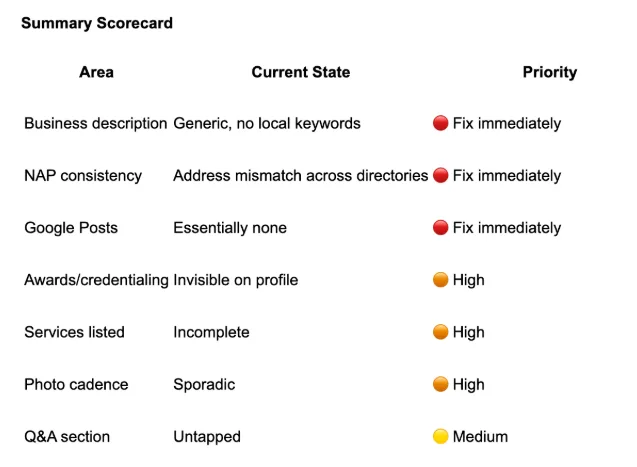
It also left little room for uncertainty. Recommendations were labeled “fix immediately,” “biggest missed opportunity,” and “clear, fixable gaps.” There was no indication that the underlying findings still needed to be verified.
That level of specificity can look a lot like expertise.
For someone who doesn’t manage Google Business Profiles every day, there was little reason to assume the recommendations hadn’t already been validated. The report was detailed, actionable, and confident about what needed to change.
But specificity isn’t the same as accuracy, and an actionable recommendation isn’t necessarily the right recommendation.
So we did what we would do with any SEO recommendation before putting it in front of a client: we validated it. That’s when the gaps in the audit itself started to surface.
What the AI audit got wrong
Once we reviewed the audit more closely, a pattern emerged. The problems weren’t limited to one inaccurate recommendation. They reflected several different ways AI can misinterpret what it finds.
| What the AI reported | What our review found | Type of problem |
| Yelp had the wrong address | The listing information was correct | Inaccurate finding |
| Google Posts were missing | Weekly updates were already being published | Existing work overlooked |
| The shared location hub created competition | The setup was part of an intentional multi-location strategy | Strategic decision misinterpreted |
| More services and photos were urgent | More isn’t inherently better, and neither was shown to be a priority | Value overstated |
| 10 GBP Q&As should be created | The recommendation relied on an outdated GBP tactic | Outdated platform knowledge |
It identified problems that didn’t exist
Some of the clearest issues were factual. The audit flagged problems that a manual review showed were not actually present.
One example was NAP consistency. Claude claimed Yelp listed an incorrect address and warned that the discrepancy could hurt local visibility. But when we checked the listing ourselves, the name, address, and phone information were correct.
It made a similar mistake with Google Posts. The audit called the lack of posts the “biggest missed opportunity,” even though the managed location already receives Google Business Profile updates every week.
Both recommendations would have sent someone looking for problems that did not exist.
That is one of the biggest risks with an AI-generated audit: a recommendation can sound precise and urgent even when the underlying observation is wrong.
It recommended work that was already being done
Other recommendations weren’t necessarily wrong in isolation. The problem was that they were presented as gaps without recognizing work that was already in place.
The audit recommended adding more local and service terminology to the business description, despite the existing description already referencing the firm’s location and relevant services. It also called for improvements in areas where there was already a defined strategy:
- Google Business Profile services
- Awards and recognition featured in weekly posts
- Office photography
- Team photography
That doesn’t mean the profile won’t continue to evolve. There may be opportunities over time to add new photos, expand services when relevant, or strengthen the description as local search intent changes. But those are ongoing optimization opportunities, not evidence that the existing strategy is incomplete.
“Could be enhanced” and “is missing” are not interchangeable.
Without that distinction, an AI audit can make existing work look like an unaddressed problem and direct attention toward changes that may not be the highest priority.
It mistook strategic decisions for mistakes
The audit also flagged intentional strategic decisions as problems because it could see how the profiles were configured, but not why they were configured that way.
The RIA has two offices in the same market. The AI saw that both Google Business Profiles linked to the same location hub and interpreted that as the offices competing against each other in local search.
What it couldn’t see was the strategy behind the setup. The profiles had been intentionally structured to support a shared local presence while using office-specific conversion paths and other profile optimizations to differentiate the individual locations.
The configuration wasn’t an oversight. It reflected our broader approach to local visibility for multi-location RIAs, where multiple offices need to build visibility within the same market without creating unnecessary overlap.
This is where client context becomes especially important. AI can evaluate what it sees, but it doesn’t automatically know the reasoning, testing, or previous decisions behind it. Without that context, a strategic choice can easily be misclassified as a mistake.
It recommended tactics without understanding their value
Some of the audit’s recommendations were technically reasonable. The problem was how confidently they were prioritized without evidence that they would meaningfully improve performance.
For example, Claude recommended creating a much longer list of individual Google Business Profile services, suggesting that more services would create more opportunities to appear for relevant searches.
Our strategy is intentionally more focused. A longer service list isn’t automatically a stronger one. We prioritize services that accurately reflect the firm’s core offerings and align with the searches that matter most rather than adding every possible variation simply to increase query coverage.
The same applies to photos. Adding fresh office and team photography can strengthen a profile, but the audit treated additional photos as a high priority without showing that the existing photo strategy was limiting performance.
A tactic can be technically reasonable and still be the wrong priority.
SEO strategy requires weighing the potential impact of a recommendation against the effort, evidence, existing strategy, and other opportunities competing for attention. A long list of optimizations isn’t valuable if it sends the team toward low-impact work first.
It relied on outdated platform knowledge
Some recommendations also reflected tactics that no longer align with how Google Business Profiles work today.
The audit recommended immediately developing 10 Google Business Profile Q&As as part of the optimization plan. But Google has been moving away from the Q&A feature, including discontinuing API support for managing Q&A. Investing significant time in building out this area would make little sense as a priority today.
This highlights another limitation of AI-generated audits: SEO recommendations have a shelf life.
A tactic that was worth prioritizing two years ago may have less value today as platforms, features, and search behavior change. Effective local SEO strategies need to evolve with those changes rather than rely on a static checklist of Google Business Profile optimizations. Before acting on an AI recommendation, someone still needs to validate that the tactic is current and worth the resources required to implement it.
Why context matters in an AI SEO audit
The problem wasn’t that every recommendation was bad. The problem was that the report couldn’t reliably distinguish between a real opportunity, something already implemented, an intentional strategic decision, and something that simply wasn’t true.
The AI lacked important context, including:
- Which locations Trustworthy Digital managed
- What work had already been implemented
- Why certain strategic decisions had been made
- Which recommendations had meaningful potential impact
- Which tactics were still relevant as Google Business Profile features changed
That context changes how an SEO professional evaluates a recommendation. Effective SEO for financial advisors requires looking beyond individual optimizations to consider the firm’s broader visibility strategy, existing work, competitive landscape, and business priorities.
We aren’t only asking, “Can we optimize this?” We’re asking whether there is actually a problem, what evidence supports the change, how it fits into the broader strategy, and whether it deserves priority over other opportunities.
An audit without context is a list of possibilities, not a strategy.
Where AI fits into SEO strategy
AI absolutely has a role in SEO. It can surface potential opportunities, analyze large amounts of information quickly, generate hypotheses, and identify areas that deserve a closer look.
But identifying an opportunity is only the beginning. Before a recommendation becomes part of an SEO strategy, it needs to move through a human layer of review:
- Validate: Confirm the issue or opportunity actually exists before recommending a change.
- Contextualize: Evaluate it against work already completed, past decisions, and the client’s broader strategy.
- Prioritize: Weigh the potential impact against effort and other opportunities competing for attention.
- Implement: Put the recommendation into practice based on the strategy and intended outcome.
- Measure: Track performance to determine whether the change produced the expected result.
AI can accelerate the analysis that feeds this process. An experienced strategist determines whether a recommendation survives the rest of it.
That’s the role we see for AI at Trustworthy Digital: helping our team work faster and investigate more possibilities without replacing the judgment required to decide what clients should actually do.

Find the opportunities actually worth acting on
A Performance Diagnostic looks beyond a list of marketing recommendations to identify the gaps with the greatest potential impact on visibility, lead quality, and qualified pipeline.
Why AI can’t own your SEO strategy
The AI audit produced a polished, detailed report in minutes. Determining which recommendations were actually useful required context and strategic judgment.
That’s the distinction between generating recommendations and building an SEO strategy.
AI can make SEO analysis faster. Expertise makes it useful.
At Trustworthy Digital, AI is part of how we work, but recommendations don’t reach clients simply because a model generated them. We validate them against the account, the platform, the data, and the strategy already in place.
The value comes from knowing which recommendations to trust, which to question, and which are actually worth acting on.