

Many RIAs publish blogs, market commentary, newsletters, and social posts, but much of it has no defined role in how prospects choose an advisor. Effective content marketing for financial advisors gives each piece a job, from discovery to evaluation to the decision to reach out.
The goal is content that builds credibility, strengthens search and AI visibility, and gives prospects a reason to trust your firm. In this guide, we’ll explain what to create, how content supports the buyer journey, and how to measure its role in your marketing plan.
Key takeaways
- Every piece of content needs a defined job: Articles, advisor bios, FAQs, and location pages should each support a specific stage of how prospects discover, evaluate, and choose an RIA.
- Ideal client questions outweigh keyword volume: A lower-volume question from a qualified prospect often carries more business value than a broad keyword that attracts irrelevant visits.
- AI search rewards expertise and structure: Direct answers, original insights, and clear connections between advisors, services, and locations help content get cited instead of bypassed.
- Pipeline contribution is the measure that matters: Track qualified leads, assisted conversions, and pipeline contribution alongside traffic to see whether content is supporting firm growth.
What is content marketing for financial advisors?
Content marketing for financial advisors is the creation and distribution of educational content that helps prospective clients answer financial questions, evaluate their options, and build confidence in an advisory firm. It includes articles, guides, videos, newsletters, FAQs, local resources, market commentary, and thought leadership.
Publishing blogs on a schedule is not the same as having a content strategy. A real strategy connects each piece to how prospects research and choose a firm:
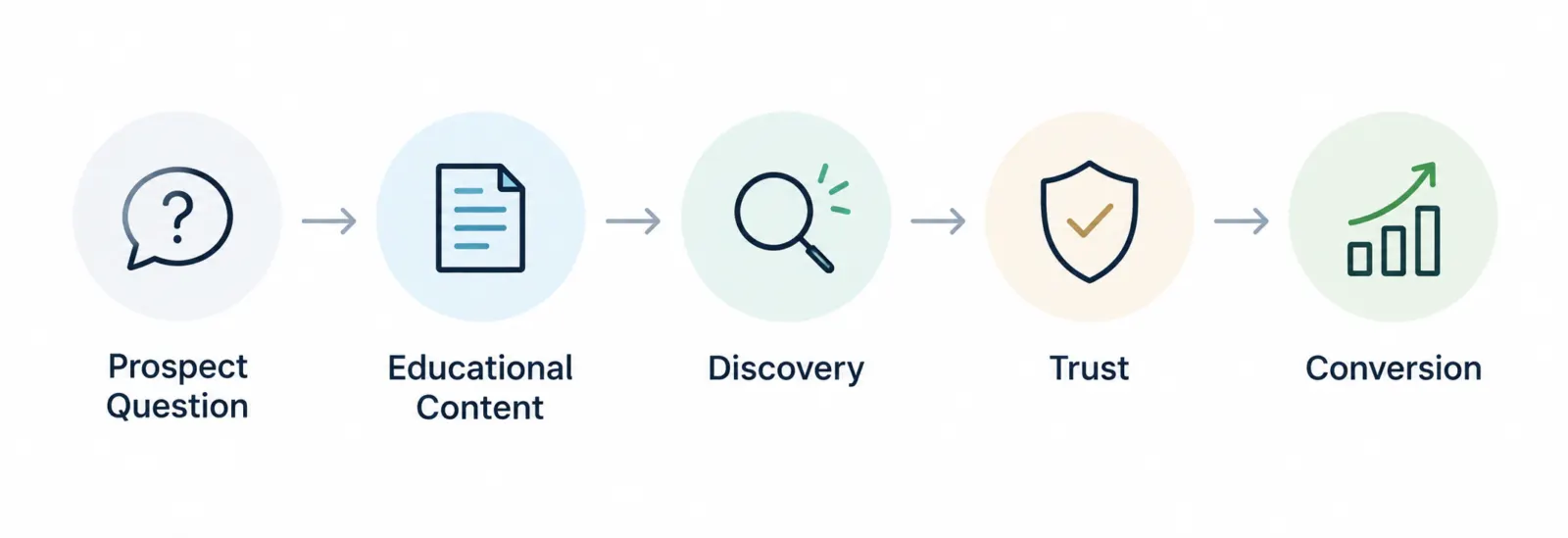
Each piece of content also has a different job in that progression. A retirement planning article introduces someone to the firm, while an advisor bio, local office page, or service FAQ helps that person decide whether to schedule a conversation.
Why content marketing matters for financial advisors and RIAs
Content marketing matters for financial advisors because prospects research extensively before contacting a firm. Useful content shapes how easily those prospects find the firm, how they perceive its expertise, and whether they trust it enough to reach out.
Builds credibility before the first conversation
Content builds credibility by showing prospects how a firm thinks before they ever fill out a form. Financial advice is inherently trust-sensitive, and prospects often evaluate a firm’s expertise long before the first meeting.
Educational content gives the firm an opportunity to demonstrate how it approaches the financial decisions its ideal clients face. The bar is higher for RIAs, since financial content faces stricter trust filters in AI search and closer scrutiny from prospects.
Strengthens organic and AI search visibility
Useful content creates more opportunities for an RIA to appear when prospects research financial questions through Google, AI Overviews, ChatGPT, Gemini, and other discovery experiences.
Visibility now comes down to two questions: whether your firm ranks for the searches prospects run, and whether its content is surfaced, cited, or bypassed when AI systems answer those questions. Firms that answer specific questions clearly give both systems more reasons to reference them.
Reinforces referrals
Content reinforces referrals by confirming the credibility a referral introduced. Someone who receives an advisor referral often still searches the firm’s name, reads an article, reviews an advisor bio, or researches a financial question before making contact.
When that research turns up specific, useful content, it validates the referral and gives the prospect more confidence to take the next step.
Creates more qualified conversion paths
Content creates qualified conversion paths by giving interested prospects a logical next step. A prospect who discovers an RIA through a useful article moves naturally into related service pages, advisor profiles, guides, assessments, or consultation requests.
This is where content shifts from generating traffic to contributing to qualified pipeline. Mapping those paths deliberately is how firms drive pipeline from content instead of adding more activity.

Turn content visibility into qualified pipeline
Content should have a clear role in how prospects discover, evaluate, and engage with your firm. See how our Revenue Performance System connects visibility, conversion, and measurement to business growth.
7 content marketing strategies for financial advisors
The most effective content marketing strategies for financial advisors start with the prospects a firm wants to reach and give every piece a clear purpose. These seven strategies cover what to create, where to focus, and how to extend content across search, AI, and other channels.
1. Build content around your ideal clients’ questions
Strong financial advisor content starts with the people the firm wants to reach, not a keyword list. Identify the decisions and transitions your ideal clients face, then build content that answers the questions they ask along the way.
Common topics for RIA audiences include:
- Retirement transitions
- Equity compensation
- Business exits
- Tax planning
- Estate planning
- Inheritance
- Divorce or widowhood
- Concentrated stock
- Charitable giving
- Multi-generational wealth
Search volume should not determine the entire strategy. A lower-volume question asked by a highly qualified prospect often carries more value than a broad keyword that generates thousands of irrelevant visits.
2. Create blog content that supports research
Blog content performs best when it answers a real question a prospect is researching, rather than filling a publishing quota. An article written only because the calendar calls for two posts a month rarely earns trust, visibility, or qualified traffic.
Different articles serve different levels of prospect intent:
| Prospect need | Example content |
| Learn | How much do I need to retire? |
| Solve | How should I diversify concentrated company stock? |
| Compare | Financial advisor vs. wealth manager |
| Evaluate | What should I look for in a financial advisor? |
| Decide | Questions to ask before hiring a financial advisor |
Educational articles also earn visibility beyond the website. In our Trustworthy Signals™ client data, blog content consistently stands out among the pages generating the most off-site signals, which is why research questions belong at the center of a high-performing content strategy.
3. Develop original thought leadership content
Original thought leadership separates an RIA from generic search engine optimization (SEO) content by showing expertise competitors cannot easily replicate. It reflects how the firm’s advisors actually think about the planning issues their clients face.
Examples of expertise-driven content include:
- Advisor perspectives on changing planning issues
- Original research or client trend analysis
- Surveys
- Commentary from subject-matter experts
- Proprietary frameworks
- Data-backed insights
AI makes generic informational content easy to produce. First-hand expertise, original data, and distinctive perspectives become more valuable as generic information becomes easier to replicate.
4. Build local content for the markets you serve
Local content shows relevance in the specific markets where an RIA competes for clients, which matters most for multi-location firms. Each office needs content that reflects its market, its advisors, and the financial issues local prospects face.
Effective local content includes:
- Location pages
- Local financial planning considerations
- Advisor and community expertise
- Regional retirement or wealth issues
- Local events and educational resources
- Locally relevant FAQs
Skip local content that has no connection to why someone hires an advisor, such as a roundup of the best restaurants in Scottsdale. A structured local visibility strategy keeps location content focused on helping qualified prospects evaluate the firm.
Apply one test to every local topic:
Would this content help a qualified prospect in this market evaluate our firm or solve a relevant financial problem?
5. Answer frequently asked prospect questions
FAQ content captures the specific, conversational questions prospects ask search engines and AI platforms before contacting a firm. Well-written answers give both systems a direct, quotable response tied to your expertise.
Prospect questions worth answering include:
- How much money do I need before hiring a financial advisor?
- What does a financial advisor charge?
- When should I hire a wealth manager?
- Do financial advisors help with taxes?
- What’s the difference between financial planning and wealth management?
Avoid adding FAQ sections simply to add keywords. Each answer should be useful and complete enough to resolve the question on its own.
6. Optimize content for AI-driven search
Optimizing content for AI-driven search makes it easier for platforms like ChatGPT, Gemini, and Google AI Overviews to understand, summarize, and cite your firm. It works best as a deliberate strategy rather than a set of scattered adjustments.
Practical answer engine optimization (AEO) and generative engine optimization (GEO) principles include:
- Give direct answers to specific questions.
- Structure content with descriptive headings.
- Define concepts clearly when necessary.
- Support claims with credible evidence.
- Include specific examples.
- Add first-hand expertise and original insights.
- Create clear relationships between the firm, advisors, services, locations, and areas of expertise.
- Keep content comprehensive enough to answer likely follow-up questions.
The key distinction is simple. SEO asks whether your content can be found. AEO and GEO also consider whether your content can help form the answer.

Is your content showing up in AI search?
Search visibility now extends beyond traditional rankings. Our AEO strategies help RIAs strengthen their visibility across AI-driven search experiences and create content that’s easier for answer engines to understand and cite.
7. Repurpose strong ideas across channels
Repurposing extends the value of a strong idea by adapting it for newsletters, LinkedIn, video, webinars, and other channels where prospects already pay attention.
A single research project, for example, can move through several formats:
Original retirement research → Blog article → Advisor LinkedIn posts → Email newsletter → Short video → Webinar talking points → FAQ content
Repurposing does not mean copying and pasting the same content everywhere. Adapt each idea to the audience, format, and channel so it earns attention on its own terms.
How content supports the financial advisor buyer journey
Content supports the financial advisor buyer journey by giving prospects what they need at each stage, from first question to first conversation. Each stage calls for a different type of content with a different job.
| Stage | Prospect behavior | Content’s job | Examples |
| Discovery | Researching a financial question | Establish visibility | Educational articles, videos |
| Exploration | Learning about possible solutions | Demonstrate expertise | Guides, thought leadership |
| Evaluation | Comparing firms or advisors | Build credibility | Advisor bios, service pages, case studies |
| Validation | Researching a referred firm | Reinforce trust | Articles, reviews, local content |
| Decision | Considering contacting the firm | Reduce uncertainty | FAQs, process content, consultation pages |
A good content strategy does not require every piece to generate a lead directly. It requires the full content ecosystem to help qualified prospects move toward a decision.
How to build a content marketing strategy for your RIA
A content marketing strategy for your RIA starts with a clear audience and ends with a measurement rhythm that shows what to improve. These six steps give your team a repeatable framework.
1. Define who you want to reach
Identify the priority client segments, markets, services, and financial needs your firm is best positioned to serve. A clear audience definition shapes every topic, format, and channel decision that follows.
2. Map their questions to the buyer journey
Map the questions prospects ask as they learn, compare, evaluate, and decide. A prospect researching retirement income asks different questions than one comparing advisors, and your content should answer both.
3. Audit the content you already have
Audit existing content before creating more, so you know what already earns visibility and where gaps remain. Look for:
- Content generating qualified organic visibility
- Content receiving AI citations
- High-traffic content with little commercial relevance
- Important prospect questions you don’t answer
- Content that should be updated, consolidated, or removed
4. Prioritize topics based on business value
Prioritize topics by business value, not search volume alone. A simple framework helps your team compare opportunities consistently:
Audience fit + business relevance + search opportunity + authority to answer = content priority
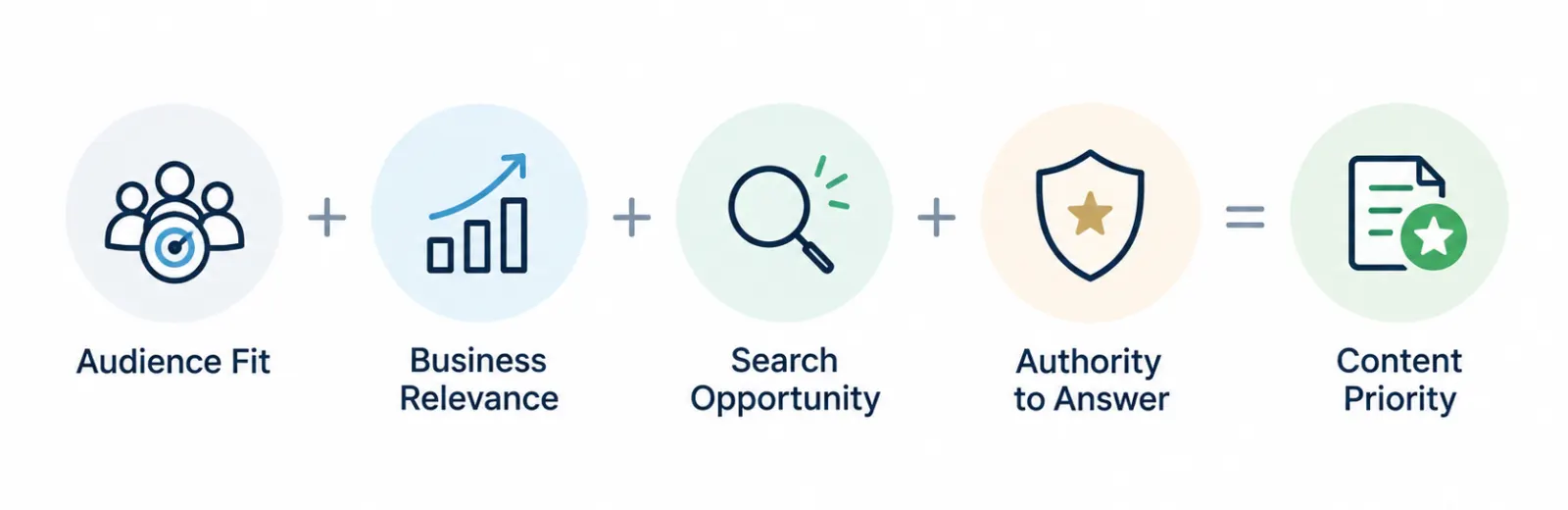
Topics that score well across all four factors deserve investment first. Topics with high search volume but weak audience fit belong lower on the list.
5. Connect content to conversion paths
Connect each piece of content to the logical next step for the reader’s intent: another resource, a service page, an advisor page, a guide, an assessment, or a consultation. Not every article needs a “Schedule a Call” button attached to it.
6. Measure and refine
Measure performance on a consistent schedule, then refine topics, formats, and conversion paths based on what contributes to qualified pipeline. The metrics below show where to focus.
How to measure financial advisor content marketing
Measure financial advisor content marketing by tracking visibility, engagement, and business outcomes together rather than traffic alone. Each metric answers a different question about whether content contributes to growth.
| Metric | What it tells you |
| Qualified organic visibility | Whether you’re reaching relevant search audiences |
| AI citations/mentions | Whether your content is being surfaced in AI research |
| Engaged sessions | Whether visitors interact with the content |
| Assisted conversions | Whether readers who view content later become leads |
| Qualified leads | Whether content attracts right-fit prospects |
| Pipeline contribution | Whether content influences business opportunities |
| Client acquisition | Whether marketing ultimately contributes to growth |
Traffic and rankings remain useful diagnostic signals. The strongest reporting connects them to qualified leads and pipeline contribution so leadership can see which content deserves more investment.
Common content marketing mistakes financial advisors should avoid
The most common content marketing mistakes come from treating content as a publishing task instead of part of a growth system. Watch for these patterns:
- Publishing based only on keyword volume
- Creating generic content AI can answer without you
- Writing for search engines instead of prospective clients
- Ignoring local search intent
- Treating every article as a direct lead-generation page
- Publishing without subject-matter expertise
- Failing to update older content
- Measuring success only through traffic and rankings
Turn content visibility into qualified pipeline
Content marketing works best when each piece has a clear role in how prospective clients discover, evaluate, and build trust in your RIA. Traffic and rankings indicate visibility, but the larger goal is a content strategy that contributes to qualified pipeline and firm growth.
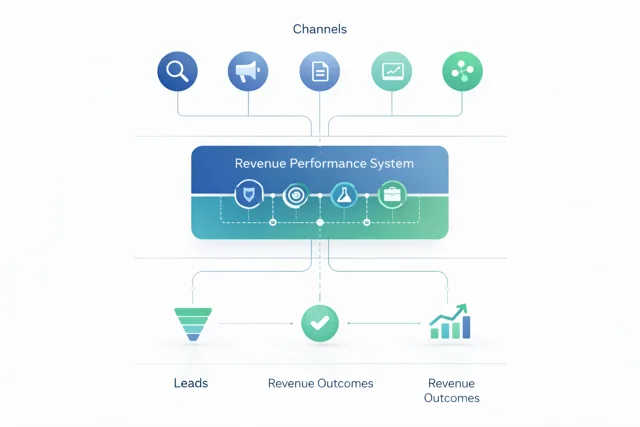
That outcome depends on content, conversion paths, and reporting working from the same definition of a qualified opportunity. Our Revenue Performance System connects those pieces so leadership can see which topics earn trust and which ones only earn clicks.
Turn your content into a growth system
Trustworthy Digital’s Revenue Performance System connects content, SEO, AEO, conversion, and measurement so your marketing works together to support qualified pipeline and measurable growth.