

RIAs have more ways than ever to reach prospective clients, but more traffic, form fills, or purchased contacts do not automatically translate into growth. The real goal is a repeatable pipeline of prospects who fit your firm’s services, expertise, geography, and ideal client profile.
This guide covers 10 financial advisor lead generation strategies across organic search, local visibility, content, AI search, paid media, referrals, events, conversion, and nurture, plus how to evaluate which strategies actually contribute to qualified pipeline.
Key Takeaways
- Lead quality matters more than volume: Lead generation should attract prospects who align with your firm’s ideal client profile, not simply maximize inquiries.
- Different channels serve different roles: Search, content, referrals, paid media, and events reach prospects at different points in their decision process.
- Trust influences prospect decisions: Expertise, advisor reputation, reviews, and a credible digital presence can all affect whether a prospect engages.
- Pipeline reveals what actually works: Connecting marketing activity to qualified opportunities helps RIAs determine which lead generation investments contribute to growth.
10 financial advisor lead generation strategies
There is no single channel that works for every RIA. The right mix depends on who your firm serves, where those prospects look for advice, and what builds enough trust for them to take the next step.
1. Improve your visibility in organic search
Search engine optimization (SEO) can generate leads by putting your firm in front of prospective clients already searching for an advisor, a wealth management service, or an answer to a financial question.
Strong performance starts with targeting keywords based on your actual services, specialties, locations, and search intent. From there, build commercial pages around high-intent searches and use educational content to capture questions earlier in the prospect journey.
- Target keywords based on real client services, specialties, and locations
- Build strong commercial pages around high-intent searches
- Use educational content to capture questions earlier in the journey
- Strengthen technical SEO, internal linking, and site architecture to support those pages
Firms that build a structured SEO strategy tend to see steadier visibility than those relying on scattered keyword targeting. For a fuller walkthrough of tactics, our guide to SEO for financial advisors covers local, content, and technical priorities in more depth.
2. Strengthen local search visibility
Local SEO helps financial advisors generate leads from prospects searching for advisors and wealth management firms in the markets where they live or work.
Optimizing Google Business Profiles for each eligible office and building unique, useful location pages gives prospects a reason to trust your firm before they ever visit your website. Reviews and consistent business information across directories reinforce that trust.
- Optimize Google Business Profiles for each eligible office
- Build unique location pages connected to advisor and service pages
- Generate and respond to client reviews
- Maintain accurate business information across relevant directories
Local search matters because financial advice remains trust and relationship-driven, even as the research process becomes increasingly digital. Firms just getting started can walk through specific local SEO strategies for building out profiles and location pages one office at a time.
Firms with several offices need a local visibility strategy built around each market rather than one blanket approach, since national brand recognition rarely translates evenly across locations.
3. Create content around your ideal clients’ questions
Educational content helps RIAs attract prospects by answering the financial questions they research before they are ready to speak with an advisor.
Start with the needs and financial decisions your ideal clients actually face, such as retirement transitions, selling a business, tax-aware planning, or choosing an advisor. Prioritize topics that demonstrate real expertise rather than broad topics chosen only for search volume.
- Address specific client decisions instead of generic topics
- Use varied formats such as articles, guides, and webinars
- Support SEO, AI visibility, and referral conversations at the same time
- Include a clear next step for interested readers
For a broader view of how these pieces fit together, see our guide to digital marketing strategies for financial advisors.
4. Build visibility in AI search
AI search creates another opportunity for RIAs to get discovered while prospective clients research financial questions, advisors, and wealth management firms.
ChatGPT, Google AI experiences, and similar platforms are changing how prospects research advisors before they ever reach a traditional search result. Optimizing content to answer specific questions clearly, paired with strong authority signals like advisor expertise and third-party mentions, improves the odds your firm gets referenced instead of skipped.
- Provide clear, direct answers to relevant prospect questions
- Build authority through advisor expertise and third-party mentions
- Track whether your firm is being cited or bypassed
- Treat AI visibility as a complement to SEO, not a replacement
Firms that invest in answer engine optimization (AEO) are more likely to earn a citation instead of getting bypassed when a prospect asks an AI platform for a recommendation.
5. Use paid search to capture high-intent prospects
Paid search gives financial advisors a way to appear immediately for searches that signal a prospect is actively looking for an advisor or a specific financial service.
Paid search works best when it focuses on queries with real commercial intent, uses negative keywords to reduce irrelevant clicks, and sends traffic to a relevant landing page instead of the homepage. Tracking what happens after the form submission is what separates a lead generation channel from a click generation channel.
Cost per lead can look efficient while cost per qualified opportunity tells a very different story. A paid growth strategy built around pipeline, not clicks, is what separates efficient paid programs from expensive ones.
6. Build strategic referral partnerships
Centers of influence can generate warm financial advisor leads by connecting RIAs with prospective clients through professionals they already trust.
Relationships with CPAs, estate planning attorneys, and other centers of influence work best when your firm clearly communicates its ideal client profile and specialties, so partners know exactly when an introduction makes sense. Treat these as mutually valuable relationships rather than a lead exchange.
- Build relationships with CPAs, attorneys, and other relevant partners
- Communicate your ideal client profile clearly
- Use educational events or joint content to strengthen the relationship
- Track referral sources to see which partnerships contribute pipeline
7. Encourage referrals from existing clients
Client referrals can produce highly qualified prospects because the introduction begins with trust already established through an existing relationship. This is different from the professional referral partnerships covered above, since the introduction here comes from someone who has already experienced your firm firsthand.
Make it easy for clients to understand who your firm is best suited to help, and create natural opportunities for them to share resources, events, or advisor expertise. A client experience people feel comfortable recommending does more for referrals than any explicit ask.
- Make client fit easy to understand and share
- Create natural sharing opportunities through events or content
- Deliver a client experience people feel comfortable recommending
- Avoid turning every client touchpoint into a referral request
Testimonial, endorsement, and solicitation rules vary by firm and jurisdiction, so confirm current requirements with the U.S. Securities and Exchange Commission and your compliance team before asking clients for referrals directly.
8. Host educational webinars and events
Events can generate financial advisor leads by bringing prospective clients into an educational setting centered on a financial decision or need that matters to them.
Choose topics relevant to specific audiences, such as approaching retirement or managing concentrated stock, rather than broad market commentary. Webinars, local seminars, or small invitation-based events all work when the topic is specific enough to matter.
- Choose audience-specific topics over broad commentary
- Use registration to gather relevant information without adding friction
- Follow up with attendees who show additional interest
- Measure qualified conversations, not just registrations
9. Improve your website’s conversion path
More visibility will not generate more opportunities if qualified prospects reach your website and cannot quickly understand who your firm serves, why they should trust it, or what to do next.
Clear ideal client fit, credible advisor profiles, and visible trust signals like credentials and reviews all shape whether a visitor takes the next step. Reducing friction in forms and connecting your content to relevant services matters just as much as the traffic driving people there in the first place.
- Communicate ideal client fit and expertise clearly
- Make advisor profiles credible, not just biographical
- Use visible trust signals like credentials and reviews
- Reduce friction in consultation and contact forms
Conversion-focused web design is usually what closes the gap between traffic and consultations. Many of the gaps that limit RIA website lead generation come down to unclear positioning, weak trust signals, or friction in the contact form.
10. Nurture prospects who aren’t ready to choose an advisor
Lead nurturing keeps an RIA relevant to qualified prospects whose needs align with your firm but whose timing is not right for an immediate conversation.
Selecting or changing advisors can involve a long decision process, so email, educational resources, and relevant updates help your firm stay useful during that window. Segmenting prospects by interest or financial need, rather than sending a single generic newsletter, keeps that communication relevant.
- Use email, resources, and events to stay useful over time
- Segment prospects by interest or financial need
- Give prospects natural opportunities to re-engage when circumstances change
- Focus on usefulness and relevance over communication frequency

How to evaluate lead generation ROI for financial advisors
Financial advisors should evaluate lead generation ROI based on the qualified opportunities and client outcomes a strategy produces, not just its cost per lead.
Lead count alone can distort performance. Ten leads that never meet your firm’s qualification criteria can be less valuable than two that become serious opportunities.
1. Measure the full path from lead to client
Traffic and visibility eventually become an inquiry, then a qualified opportunity, then a consultation, then a client, then revenue. Connecting marketing and CRM data wherever possible lets your team see what happens after that first form fill instead of stopping at the click.
2. Track lead generation beyond the initial conversion
Leads generated and cost per lead are useful starting points, but they will not tell you whether marketing is producing viable opportunities. The further you connect marketing data to CRM and client outcomes, the better you can evaluate actual lead generation performance.
| Metric | What it helps measure |
| Leads generated | How many inquiries a channel produces |
| Qualified lead rate | How many inquiries meet your firm’s qualification criteria |
| Consultation conversion rate | How often qualified prospects progress to an advisor conversation |
| Cost per qualified opportunity | How much marketing investment is required to create a viable opportunity |
| Client conversion rate | How often qualified opportunities become clients |
| Client acquisition cost | How much your firm spends to acquire a new client |
| Pipeline contribution | How much qualified pipeline a channel generates or influences |
3. Account for multiple touchpoints
A prospect may discover an article through Google, return through an advisor search, read reviews, attend a webinar, and eventually convert through branded search. First click and last click reporting can oversimplify the role each channel actually played, which is why combining analytics, attribution, and CRM data matters.
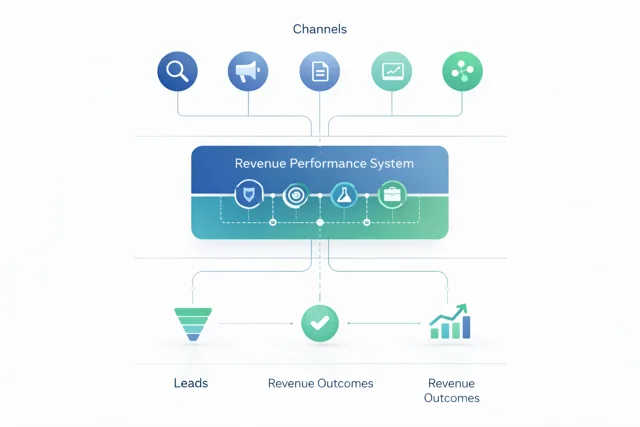
Connect marketing activity to qualified pipeline
Trustworthy Digital’s Revenue Performance System connects channel execution, conversion, and measurement so RIA leaders can see what’s contributing to growth and make better decisions about where to invest.
Should financial advisors buy leads?
Buying financial advisor leads can create immediate contact volume, but you need to evaluate lead quality, exclusivity, intent, and acquisition cost before treating purchased leads as a scalable growth channel.
Purchasing leads is different from generating demand through owned and earned channels. Shared leads may be sold to multiple advisors, and contact information alone does not indicate genuine intent or fit. A low cost per lead can become expensive fast if few prospects actually qualify or convert.
- Evaluate any provider by lead source and exclusivity
- Check qualification criteria and replacement or refund policies
- Track downstream conversion, not just initial contact volume
- Avoid assuming purchased leads simply do not work
Raw contact volume is meaningless without quality and downstream measurement behind it. That distinction matters just as much when evaluating a financial advisor lead generation service as it does when building a channel strategy in-house.
Build a lead generation system around qualified pipeline
Financial advisors have many ways to generate leads, but no single tactic creates a sustainable growth system on its own. The right mix depends on your ideal clients, specialties, markets, existing visibility, and growth goals.
Strong lead generation for financial advisors creates visibility, earns trust, gives prospects a clear path to engage, and provides enough measurement to determine what actually contributes to pipeline. If your firm is generating activity without a clear picture of what is driving qualified opportunities, the next step is understanding where the gaps sit across visibility, conversion, channel performance, and measurement.
Get Your Performance Diagnostic