

Attribution is figuring out which marketing efforts deserve credit for new clients. For RIAs, that is especially hard: referrals, long decision cycles, and offline conversations blur the path. Marketing Mix Modeling (MMM) and Multi-Touch Attribution (MTA) solve different measurement problems, and choosing wrong wastes budget.
In this article, we compare how MMM and MTA work, their strengths and limitations, when each model fits a growing advisory firm, and how combining them with strong analytics and attribution helps leadership make more confident decisions about where the next marketing dollar should go.
Key takeaways
AI search visibility is often underreported: Citations in AI answers build awareness without direct clicks, so traditional attribution models tend to undercount their impact.
MMM guides long-term budget decisions: It uses aggregated historical data to show which channels drive growth over months, making it useful for annual planning across online and offline efforts.
MTA optimizes digital campaigns: It tracks individual touchpoints to show which ads, keywords, and content influence conversions, but depends on user-level data that privacy changes can disrupt.
Neither model captures the full RIA journey alone: Referrals, events, and advisor conversations happen offline, so firms need measurement that connects marketing activity to CRM and pipeline data.
Many firms benefit from using both: MMM shows which channels deserve investment, while MTA shows how to optimize spend within them.

What is Marketing Mix Modeling (MMM)?
Marketing Mix Modeling is a statistical approach that uses historical data to measure how different marketing channels and external factors impact your business outcomes. Instead of tracking individual customer journeys, MMM analyzes patterns across your entire marketing ecosystem to reveal which investments move the needle. Interest in MMM has grown significantly in recent years as privacy regulations and tracking limitations push marketers toward aggregate measurement models.
How MMM works
Here’s a concise, jargon-free overview of how MMM analyzes your historical data to reveal what’s actually working.
- Marketing Mix Modeling takes a comprehensive view of your marketing performance across all channels
- It feeds historical data from all your marketing channels into statistical models (computer programs that find patterns in your data)
- The models identify which activities correlate with new client growth, revenue, or qualified leads
- It accounts for external factors like seasonality, economic conditions, and competitive activity
- The analysis isolates the true impact of your marketing efforts from other business variables
- MMM shows how channels like SEO, paid media, and events contribute to qualified consultations over time
Data sources
MMM works with the data you already have, no complex tracking required.
- Media spend across all channels (paid search, social, events, seminars, print)
- New client, asset growth, and revenue data
- External factors like seasonality, pricing changes, promotions, and economic indicators
- Competitor activity and market conditions
- Website traffic and engagement metrics
- Referral volume and CRM pipeline data
Strengths
While other agencies chase vanity metrics, MMM focuses on what actually grows your firm.
- Great for long-term strategic planning: Shows which channels drive sustained growth over months or quarters, not just short-term spikes
- Doesn’t require user-level tracking: Works with aggregated data, though it does require significant historical data and scale to produce reliable models
- Resilient to privacy changes: iOS updates and cookie deprecation have far less effect on your MMM insights. We’ve seen firms maintain measurement clarity while competitors scramble to adapt when privacy regulations shift
Limitations
MMM has limitations, and that’s okay. Its constraints help you decide if it’s the right tool for your goals.
- Not real-time: Models need weeks or months of data to produce reliable insights, so you can’t optimize campaigns in real-time
- Limited granularity: Shows channel performance but can’t tell you which specific ads or keywords work best
- Complex setup: Requires statistical expertise, clean data integration, and enough historical volume, which smaller firms often lack

What is Multi-Touch Attribution (MTA)?
Multi-Touch Attribution tracks individual customer interactions across digital touchpoints to show exactly how prospects move through your funnel before converting. MTA gives you a granular view of which ads, emails, and content pieces influence each consultation request or lead.
How MTA works
MTA tracks your customers across the web with detailed precision, which is incredibly valuable for optimization. Here’s a breakdown of how Multi-Touch Attribution tracks and evaluates customer journeys:
- Multi-Touch Attribution places tracking pixels and cookies to monitor every click, view, and interaction
- It follows prospects across devices and platforms as they engage with your brand
- When someone converts, MTA assigns credit to different touchpoints based on attribution models
- Attribution models include linear (equal credit to all touches), time-decay (more credit to recent interactions), or U-shaped (emphasizes first and last touches)
- This detailed tracking shows exactly how prospects move through your funnel before converting
- The data shows how prospects engage with your content before requesting a consultation
Common attribution models
Multi-Touch Attribution supports several models for assigning conversion credit. Here are the most widely used:
- Linear attribution: Equal credit to every touchpoint in the customer journey
- Time-decay attribution: More credit to interactions closer to conversion
- U-shaped attribution: Heavy credit to first and last touches, lighter credit to middle interactions
- Position-based attribution: Customizable credit distribution based on your business model
Strengths
MTA gives you the near-real-time data you need to optimize campaigns and improve performance quickly.
- Real-time granularity: Track specific ads, keywords, and creative assets that drive conversions within hours
- Faster campaign optimization: Quickly shift budget from underperforming efforts to what’s working without having to wait for monthly reporting cycles
- Customer journey clarity: Gain a clear understanding of how prospects interact with your firm at every stage
Limitations
Despite its strengths, MTA has blind spots that can skew your strategy if you’re not aware of them.
- Dependent on user-level data: Privacy changes (like iOS updates or cookie restrictions) can break tracking and leave major gaps in your data
- Limited to digital channels: MTA doesn’t account for the influence of events, seminars, referrals, or word-of-mouth, which means key drivers of awareness go unrecognized
- Bias toward last-click: Some MTA implementations still overvalue bottom-funnel actions, underestimating the role of upper-funnel efforts like organic search or content marketing
That’s why RIAs continue to invest in SEO for financial advisors, along with emerging approaches like AI search optimization and Generative Engine Optimization (GEO). These efforts build awareness, trust, and discoverability, which lay the groundwork for conversions that models like MTA often underreport or overlook.
MMM vs. MTA: what’s the difference?
Here’s the straightforward comparison most agencies won’t give you about these attribution models. The decision between MMM and MTA impacts everything from your measurement accuracy to your budget allocation strategy.
Measurement focus
When comparing MMM and MTA, the core difference is scope. MMM analyzes aggregate patterns across your entire marketing ecosystem, while MTA tracks individual customer journeys through digital touchpoints. Think strategic overview versus tactical microscope.
Time horizon
MMM provides strategic insights for long-term planning and budget allocation, while MTA delivers tactical data for immediate campaign optimization. One helps you plan next year’s budget, the other helps you improve tomorrow’s ads.
Data requirements
MMM uses aggregated data (combined information from all your customers, rather than tracking individuals) from multiple sources without needing user-level tracking. MTA requires detailed tracking of individual user interactions across devices and platforms. Privacy laws work well with MMM and create challenges for MTA.
It’s worth noting that MMM can estimate digital channel performance too, but only at an aggregate level rather than the granular insights MTA provides.
Use cases comparison
| Aspect | Marketing Mix Modeling (MMM) | Multi-Touch Attribution (MTA) |
|---|---|---|
| Best For | Annual planning, budget allocation across channels | Campaign optimization, A/B testing |
| Data Type | Aggregated, historical | Individual user-level, real-time |
| Privacy Impact | Minimal, works without user tracking | High, relies on cookies and pixels |
| Update Speed | Weeks to months | Hours to days |
| Channel Coverage | All channels (online and offline) | Digital channels only |
| Strategic Value | High for long-term decisions | High for tactical optimizations |
Choosing the right model for your firm
Your firm’s growth stage and marketing mix will guide you to exactly which model fits your needs.
When to use MMM
Marketing Mix Modeling is ideal when you need strategic insights for budget planning and operate across multiple, often offline, marketing channels.
- Multi-location firms with significant event, seminar, or offline marketing spend
- Firms where compliance and privacy requirements limit user-level tracking
- Firms focused on long-term brand equity rather than immediate conversions
- Firms allocating budgets across events, print, sponsorships, and digital channels
When to use MTA
Multi-Touch Attribution is best when you need granular, user-level data to fine-tune digital performance and have reliable tracking across touchpoints.
- Firms with digital-first lead generation, like paid search and landing page campaigns
- Teams running active paid search and social campaigns
- Teams that need to optimize ad spend in real time
- Firms investing primarily in paid search, social media, and display advertising
- Marketing teams that rely on detailed data to maximize digital ROI
Why many firms use both
Many firms combine MMM and MTA for comprehensive measurement that covers strategic planning and tactical optimization.
- Use MMM to guide annual budget allocation and long-term investment decisions
- Use MTA to manage campaigns daily and test creative performance
- MMM shows which channels deserve more investment
- MTA reveals how to optimize spend within those channels
- Together, they deliver strategic clarity and tactical precision
We consistently see that firms using a hybrid approach make more confident budget decisions and optimize faster than those relying on a single attribution method. For RIAs, that combination is central to full-funnel marketing, where referrals and long decision cycles make single-model attribution misleading.

Beyond MMM vs. MTA: the future of marketing measurement
Marketing measurement is changing fast, and agencies that stick with old methods are getting left behind. Here’s what’s emerging:
Incrementality testing
This solves a major problem: figuring out what actually caused your results versus what just happened at the same time. If new consultations rise during a big campaign, did the ads drive them, or would those prospects have reached out anyway?
Incrementality testing compares similar groups (some who see your ads and some who don’t) so you can see the real impact of your marketing. When paired with MMM, it validates results with experimental data.
Unified measurement platforms
New platforms combine the best of both worlds. Instead of choosing between MMM’s big-picture insights and MTA’s detailed data, you get both in one dashboard. See which marketing channels deserve more budget while also seeing exactly which ads and keywords to optimize within those channels.
Privacy-focused solutions
Privacy laws like GDPR, CCPA, and platform changes such as Apple’s iOS updates have made user-level tracking less reliable. Advanced measurement solutions now use aggregated, privacy-safe data to provide accurate insights without collecting personally identifiable information. For RIAs, cookie consent choices on your own website add another gap to plan around.
These tools often rely on data clean rooms, modeled conversions, and secure API connections to merge data from multiple platforms while respecting privacy rules. The result: marketers can still track performance trends, understand channel impact, and make confident budget decisions without risking compliance issues or losing accuracy as tracking limitations increase.
AI search impact
As Google’s AI Overviews, Perplexity, and ChatGPT become more prominent, marketers are investing in Answer Engine Optimization (AEO) and Generative Engine Optimization (GEO). These efforts are strategies to show up in AI-powered search results. They often don’t result in direct clicks, which means traditional attribution models like MTA tend to underreport their impact.
At Trustworthy Digital, we build measurement that accounts for privacy shifts and AI-driven discovery, including where your firm is cited or bypassed with Trustworthy Signals™.
Making smarter attribution decisions: 3 factors to consider
Your attribution strategy should reflect more than just a model choice. It needs to align with your growth goals, data capabilities, and long-term plans. The three factors below will help guide a smarter, future-ready decision.
1. Firm stage and marketing objectives
Your growth stage and goals shape which model delivers real value.
Are you optimizing short-term performance or making long-term investment decisions? MMM is ideal for strategic budget planning, while MTA supports rapid campaign optimization. Choose a model that aligns with how your firm actually operates today.
2. Data infrastructure and privacy constraints
Your attribution model is only as strong as your data foundation.
MTA requires detailed, user-level data across platforms, making it vulnerable to tracking limitations and privacy regulations. MMM, on the other hand, works with aggregated data and performs well even in low-data or privacy-constrained environments.
3. Scalability and future readiness
Choose a model that works now but won’t limit you later.
Even if you’re starting with a single channel or a small team, your measurement strategy should evolve with your firm. Many firms combine MMM and MTA for a more flexible, future-proof approach that balances strategic planning with tactical agility.
Build an attribution strategy that works
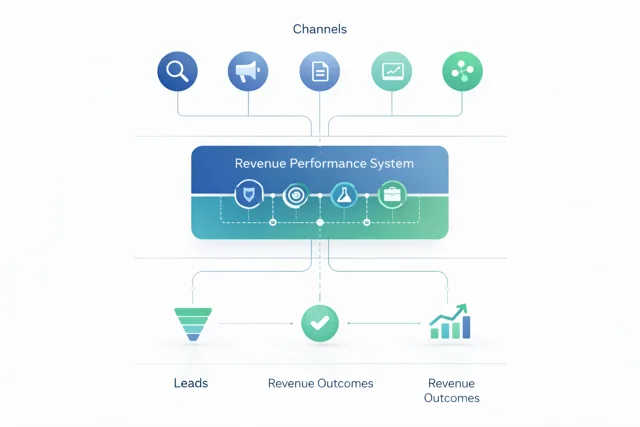
We help RIAs navigate these attribution choices and build measurement frameworks that connect marketing activity to qualified pipeline. The Revenue Performance System ties attribution, reporting, and channel execution together so leadership knows where to invest next.