

Most wealth management firms have plenty of marketing options. The challenge is consistently reaching the right affluent prospects and showing why the firm deserves a place on their shortlist. High-net-worth individuals bring complex financial needs, established professional relationships, and no shortage of advisory choices.
Marketing to high-net-worth individuals must reflect how they research firms, evaluate expertise, and decide whom to trust. In this guide, we’ll cover what affluent prospects expect, which financial advisor lead generation strategies registered investment advisors (RIAs) use to reach them, and how to measure results.
Key takeaways
- Fit matters more than wealth alone: The strongest high-net-worth prospects are those whose financial needs match your firm’s expertise, service model, and ideal client profile.
- Specific messaging earns consideration: Affluent prospects respond to firms that speak directly to their financial complexity, such as business exits, concentrated stock, or multigenerational planning.
- Referrals still need digital reinforcement: Referred prospects research your website, advisors, and search presence before reaching out, so weak visibility can undermine a strong introduction.
- Qualified opportunities are the real measure: Track qualified inquiries, consultation conversion, and cost per qualified opportunity instead of judging marketing by traffic, impressions, or lead volume.
What is high-net-worth marketing?
High-net-worth marketing is the process of attracting and engaging affluent individuals through strategies that emphasize financial expertise, credibility, personalized communication, and long-term relationships. Definitions of this audience vary by firm and source, but most fall into two segments:
- High-net-worth (HNW) individuals: Generally defined as people with $1 million or more in investable assets.
- Ultra-high-net-worth (UHNW) individuals: Often defined as people with $30 million or more, typically with more complex, multidisciplinary planning needs.
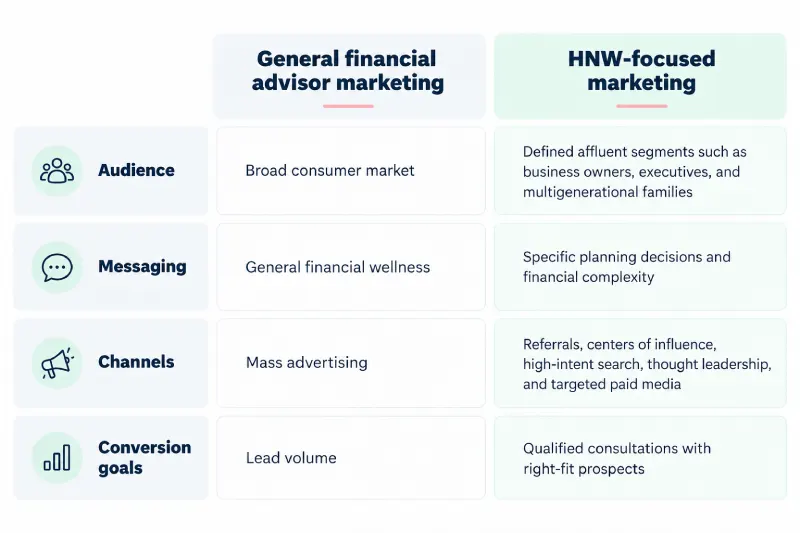
Marketing to these audiences differs from traditional financial advisor marketing because broad-market advertising built for volume tends to underperform with specialized, high-value relationships. Affluent prospects want evidence that a firm understands situations like theirs, so marketing works best when it reflects the firm’s services, expertise, and ideal client profile.
What do high-net-worth individuals look for in a wealth management firm?
High-net-worth individuals look for a firm that understands their financial situation, earns their trust, and can support them for decades. Priorities shift with wealth source, life stage, family circumstances, and financial complexity, so affluent prospects rarely behave as a single audience.
Specialized financial expertise
Affluent prospects often need more than investment management. Tax-efficient wealth strategies, estate planning coordination, concentrated stock positions, business succession, and multigenerational planning all require specialized knowledge, and prospects look for firms that demonstrate experience with the specific decisions they face.
Trust, reputation, and discretion
Credibility strongly influences whether a high-net-worth prospect keeps evaluating a firm. Advisor credentials, professional reputation, transparency around fees and process, and careful handling of sensitive financial information all signal whether the firm deserves access to a family’s complete financial picture.
Personalized service and communication
Affluent clients expect recommendations that reflect their circumstances rather than a standard playbook. Responsive communication, access to the right specialists, and an advisory relationship built around their goals all shape how prospects compare one firm against another.
Confidence in long-term relationships
Choosing a wealth manager is a long-term decision, so prospects weigh continuity alongside expertise. Advisor accessibility, succession planning within the firm, and the ability to support changing needs, from a business sale to a wealth transfer, influence whether a prospect feels confident committing.
10 marketing strategies to attract high-net-worth clients
Attracting high-net-worth clients requires a coordinated approach that combines clear positioning, a credible digital presence, professional relationships, and patient follow-up. These 10 strategies work best together, with each one supporting a specific stage of how affluent prospects discover, evaluate, and choose a firm.
1. Define your ideal high-net-worth client
An ideal client profile defines which affluent prospects your firm serves best, and it should come before any investment in marketing channels. Without one, campaigns attract wealthy prospects whose needs don’t match the firm’s expertise.
A strong profile accounts for:
- Investable assets and minimum relationship requirements
- Wealth source, such as business ownership, executive compensation, or inheritance
- Financial complexity and the services each client needs
- Geographic markets where the firm can serve clients well
- Life stage and major financial transitions
An RIA specializing in business owners preparing for liquidity events needs a different content and acquisition strategy than one serving retired executives. More affluent prospects are not automatically better prospects; the goal is attracting individuals whose needs align with the firm’s expertise and service model.
2. Build messaging around financial complexity and client needs
Messaging that names specific financial challenges differentiates an RIA more effectively than generic promises of personalized service. Affluent prospects compare several firms, and the ones that clearly describe who they serve are easier to remember and trust.
Strong high-net-worth messaging includes:
- Clear positioning around the firm’s ideal clients
- Specific expertise and planning capabilities
- The meaningful financial decisions and transitions the firm helps clients navigate
- What differentiates the firm’s approach from competitors
Compare two homepage headlines. “Personalized wealth management for your future” applies to almost any firm. “Wealth planning for business owners preparing for a sale” or “Tax-aware strategies for executives with equity compensation” tells the right prospect immediately that they’ve found a firm built for situations like theirs.
3. Create a website that establishes credibility
An RIA’s website is often the main evaluation point for affluent prospects, especially after a referral. Referred prospects usually search the firm, review advisor bios, and scan service pages before deciding whether the introduction is worth pursuing.
A credibility-focused website includes:
- Clear positioning and service explanations
- Advisor biographies, credentials, and professional experience
- Thoughtful design and intuitive navigation
- Mobile usability and fast page speed
- Transparent, low-friction consultation paths
- Appropriate testimonials, case studies, and other compliant trust signals
Strong financial advisor website design helps prospects confidently evaluate the firm. Visual polish helps, but credibility comes from clear answers about fit, expertise, and what happens after a prospect reaches out.
4. Develop thought leadership that demonstrates expertise
Thought leadership demonstrates expertise by addressing the actual questions and decisions affluent prospects face. Generic market commentary rarely sets a firm apart, while specific guidance on complex planning topics shows how the firm thinks.
High-value topics include:
- Planning for a business sale or liquidity event
- Managing concentrated equity positions
- Estate planning considerations for multigenerational families
- Tax considerations around significant financial transitions
- Wealth planning for executives approaching retirement
Educational articles, advisor-authored insights, webinars, and downloadable resources each give prospects a different way to engage. A focused content marketing strategy assigns each format a role, and specific, well-structured answers make the firm more discoverable in both traditional and AI-powered search.
5. Improve visibility across Google and AI search
Search visibility matters even for referral-driven firms, because affluent prospects research advisors on Google and AI platforms before and after an introduction. Firms missing from those results lose consideration they never knew they had.
Visibility for high-net-worth audiences depends on:
- SEO for high-intent wealth management searches
- Local SEO for affluent markets and office locations
- Educational content targeting complex financial questions
- Answer engine optimization (AEO) for direct answers
- AI search visibility across ChatGPT, Google AI Overviews, and other discovery platforms
- Consistent firm and advisor information across relevant third-party sources
Being visible for the right questions matters more than attracting large amounts of unrelated traffic. Strong search engine optimization concentrates on the specific searches affluent prospects run, such as:
- “wealth management for business owners”
- “financial advisor for executives with stock options”
- “estate planning and wealth management firm in [city]”
- “how to choose a wealth manager after selling a business”

Can High-Net-Worth Prospects Find Your Firm in AI Search?
Our AEO strategies help RIAs strengthen visibility across ChatGPT, Google AI Overviews, and other AI platforms, so your expertise is surfaced when prospects research their options.
6. Strengthen your firm’s online reputation
Online reputation reinforces trust during evaluation by giving affluent prospects outside evidence that a firm and its advisors are credible. Prospects who find consistent, current information across Google and professional directories feel more confident taking the next step.
A strong digital reputation includes:
- Google Business Profile optimization
- Relevant third-party directories and advisor profiles
- Consistent credentials, bios, and business information
- Client reviews and testimonials where permitted under applicable regulations
- Monitoring of branded search results and online mentions
Consistent local SEO strategies keep Google Business Profiles and directory listings accurate across every office. Testimonials, endorsements, and performance-related claims fall under the SEC Marketing Rule, so route them through compliance and confirm how your firm is permitted to solicit and display client feedback.
7. Build referral relationships with centers of influence
Centers of influence are trusted professionals who already advise high-net-worth individuals, which makes them a strong source of qualified introductions. Their recommendations carry weight because the prospect already trusts their judgment.
Valuable referral partners include:
- Estate planning attorneys
- Certified public accountants (CPAs) and tax professionals
- Business attorneys
- Mergers and acquisitions (M&A) advisors
- Other relevant professional intermediaries
Co-authored educational resources, collaborative events, and ongoing relationships give partners a reason to recommend your firm, while a credible website and detailed advisor profiles give them resources to share. Review referral, endorsement, and compensation
arrangements with compliance before formalizing them.
8. Use targeted paid advertising to reach qualified prospects
Paid advertising complements organic visibility and referrals by reaching affluent prospects when they are actively searching or match a defined professional audience. It works best as a targeted acquisition channel rather than a volume play.
Effective high-net-worth paid media includes:
- Google Ads targeting relevant financial planning searches
- LinkedIn campaigns reaching executives, business owners, and other relevant professional audiences
- Geographic targeting in priority markets
- Retargeting where appropriate and privacy-compliant
- Landing pages tailored to specific client segments
Paid platforms can’t target by verified wealth, and professional or geographic signals only approximate fit, so landing pages must still screen prospects. Firms weighing paid search against paid social should judge each by consultation quality, and a disciplined paid growth strategy ties spend to acquisition costs.
9. Host educational events and personalized experiences
Small, topic-focused events help RIAs build relationships with affluent prospects by addressing a specific planning need in a setting that allows real conversation. They give prospects a low-pressure way to evaluate advisors.
Formats that resonate include:
- Business succession planning roundtables
- Estate planning discussions with attorneys
- Executive compensation workshops
- Private educational events for business owners
- Virtual sessions addressing timely planning considerations
Event effectiveness depends on relevance, audience fit, and meaningful follow-up rather than exclusivity for its own sake. Targeted email campaigns, advisor networks, and centers of influence help fill seats with prospects who fit.
10. Create personalized follow-up and nurture strategies
Nurture strategies keep an RIA relevant to affluent prospects who are researching options but aren’t ready to engage. High-net-worth decisions often unfold over months, so consistent, useful communication keeps the firm in consideration.
A strong nurture program includes:
- Segmenting email communication by client interests
- Sharing relevant educational resources
- Following up after events and consultations
- Maintaining appropriate CRM records
- Creating communication paths that respect privacy and individual preferences
Tracking engagement helps tailor follow-up, but it must respect privacy expectations and applicable cookie consent requirements. Marketing should support extended consideration with relevant, well-timed communication instead of overwhelming prospects with generic follow-up.
How to measure high-net-worth marketing performance
Measuring high-net-worth marketing means tracking qualified opportunities and new client relationships rather than traffic, impressions, or lead volume. Strong analytics and attribution connect these metrics to the channels that produced them.
| Metric | What it measures | Why it matters |
| Qualified inquiries | Prospects who meet the firm’s ideal client criteria | Helps distinguish valuable opportunities from general inquiries |
| Consultation conversion rate | Percentage of inquiries that become advisor consultations | Shows how effectively marketing converts interest into conversations |
| Cost per qualified opportunity | Marketing spend divided by qualified opportunities generated | Helps identify which channels attract suitable prospects efficiently |
| Opportunity-to-client conversion rate | Percentage of qualified opportunities that become clients | Reveals how effectively the firm converts qualified prospects into relationships |
| Pipeline value | Potential assets under management (AUM) or revenue from qualified opportunities | Connects marketing activity to potential business growth |
| Client acquisition cost | Total acquisition investment divided by new clients acquired | Helps evaluate the cost of acquiring new client relationships |
Five highly qualified prospects can be worth more than 100 inquiries that don’t meet the firm’s client criteria. Trustworthy Digital’s Revenue Performance System connects visibility, conversion, and attribution so firms can see which channels contribute to qualified pipeline and long-term growth.
Common mistakes to avoid when marketing to high-net-worth individuals
The most common mistakes come from treating affluent prospects like a general audience or measuring the wrong outcomes.
- Relying entirely on referrals: A weak digital presence can undermine credibility when referred prospects research the firm.
- Using generic wealth management messaging: Broad promises make it difficult for prospective clients to identify specialized expertise.
- Prioritizing exclusivity over relevance: Premium branding and private events are no substitute for useful information and demonstrated capabilities.
- Targeting too broad an audience: Unfocused campaigns generate inquiries that don’t meet the firm’s client criteria.
- Measuring activity instead of opportunities: Traffic, clicks, and impressions provide limited insight without lead qualification and pipeline measurement.
- Overlooking compliance and privacy: Marketing programs need appropriate review processes for claims, testimonials, advertising, and prospect information.
Build a marketing strategy that attracts the right clients
Effective high-net-worth marketing depends on a clear understanding of your ideal clients, credible differentiation, and a coordinated approach to visibility and relationship development. Firms that align those pieces attract prospects who already fit, which makes every consultation more productive for both sides.
Trustworthy Digital helps RIAs connect SEO, AI search visibility, paid media, website performance, and attribution to the outcomes that matter: qualified opportunities and sustainable growth. A Performance Diagnostic shows where your current marketing attracts the right prospects and where it falls short.
Find out where affluent prospects are slipping away
A Performance Diagnostic reviews your visibility, website experience, conversion paths, and measurement to show where qualified high-net-worth opportunities are being lost and what to fix first.